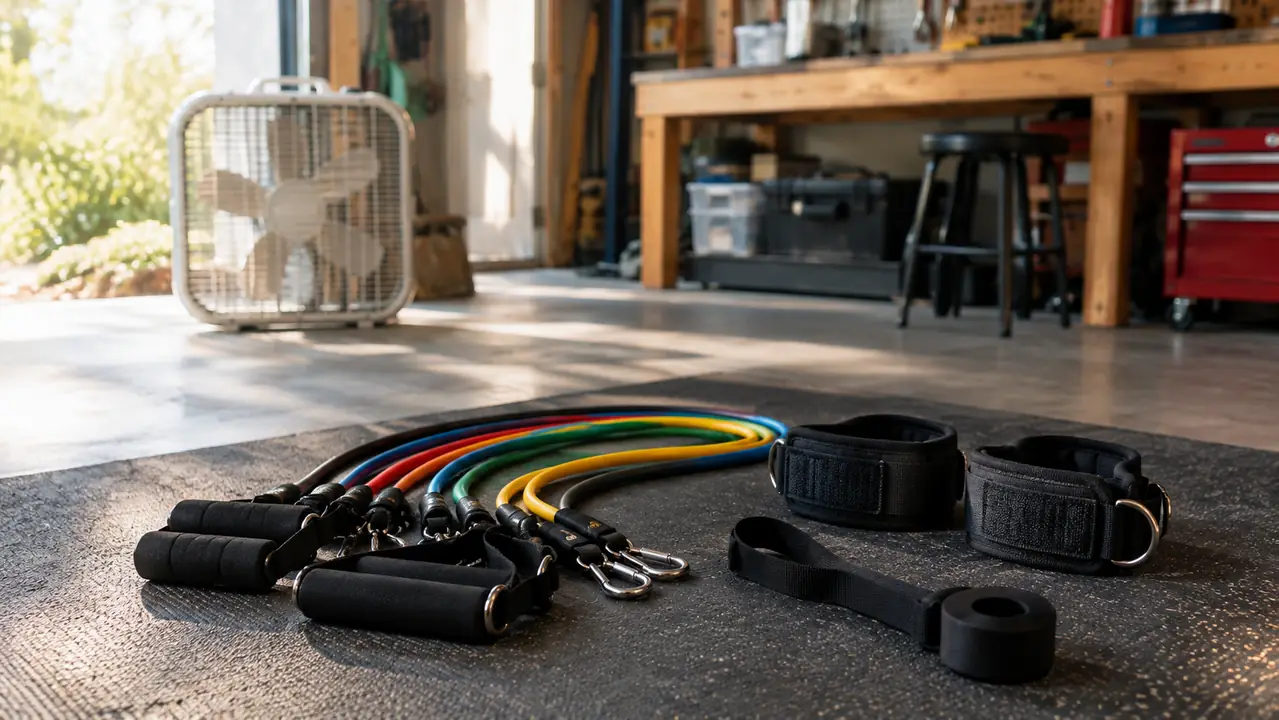
Five forty-five in the morning, garage door half open, box fan on, and the TheFitLife resistance bands are already on the mat where I left them. That is the whole review in one scene. After months of owning them, I do not have to dig them out of a drawer, untangle them, or remember how the door anchor goes together. I just pick them up and start. For a guy who fits his workouts in before work, that matters more than any spec on the box.
My left knee has been cranky since my pickup basketball days, and at 51 I am not interested in proving anything to a barbell. I wanted something that would let me train shoulders, arms, back, and legs without loading the knee under a deep squat. The TheFitLife set has become the backbone of that setup.
I have owned cheap bands before. The kind that snap after a few months and leave you holding a broken loop and a bruised ego. That is why I was suspicious of a set with this many pieces. Months later, I have stopped waiting for them to fail.
The Quick Verdict
These TheFitLife bands live in my garage, they get used three or four mornings a week, and after months of near-daily use the resistance still feels consistent. Not fancy, but they do exactly what I need.
Amazon Check Today's Price →I have used these bands for months. They are still the first thing I reach for.
The full set comes with five resistance levels, handles, a door anchor, and ankle straps. If you want to see today's price and the current reviews, the link is below.
Amazon Check Today's Price on Amazon →How I've Used It
My routine is the same most weeks. Three or four mornings, usually Tuesday, Thursday, Saturday, and sometimes Sunday, I am in the garage by 5:45. I warm up with some band pull-aparts and shoulder work, then move through a circuit. The whole session runs 30 to 40 minutes. On Saturdays I stretch it closer to an hour and take my time.
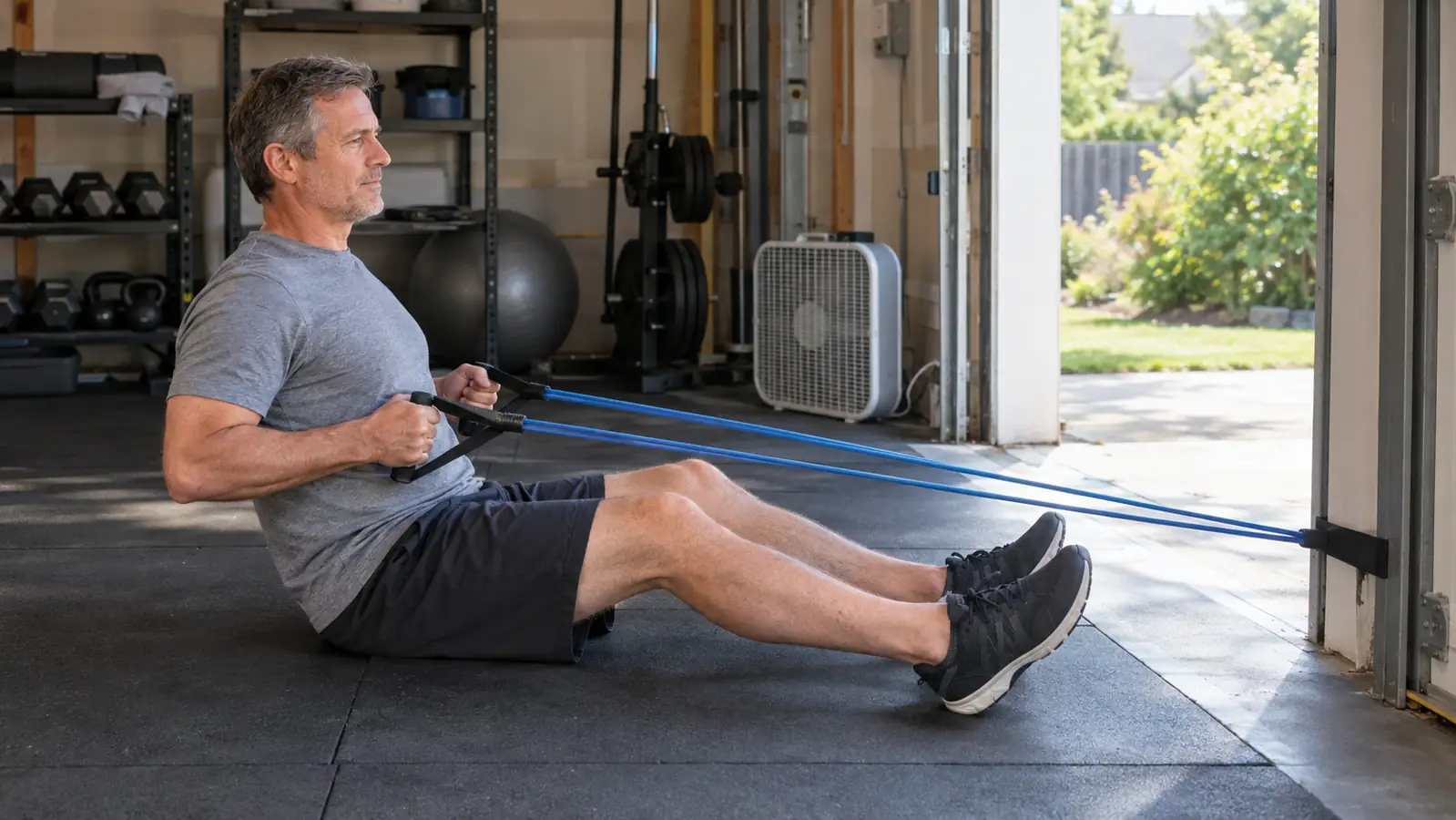
The bands do most of the work in that hour. I use the handles for rows and curls, the door anchor for chest presses and face pulls, and the ankle straps for glute work and leg raises. Carmen, my wife, uses them too, mostly for banded squats and shoulder work while I am on the other side of the garage. That means the set gets handled by two people across a normal week, and it has held up.
I keep them in the drawstring bag they came in, hanging on a hook by the workbench. The door anchor stays in the door frame when I am using it, and the whole setup takes under a minute. That convenience is the reason I still use them. Gear that takes ten minutes to set up does not get used at 5:45 in the morning.
What Months of Use Did to the Bands
The thing I was most worried about was the bands losing tension. Cheap bands stretch out, get sticky, or develop little cracks where they fold. After months of use, I have not seen any of that. The lightest band still feels like it did on day one, and the heaviest one still gives me a genuine struggle on rows.
The set has five resistance levels, marked from light to heavy. I mostly live on the middle two bands, and I use the heaviest one for rows and deadlifts. The bands sit comfortably against my forearms during curls and do not roll or pinch the way some tube bands did when I borrowed a friend's set years ago.
The handles and carabiners have held up too. The handles still feel solid, and the stitching on the straps is still tight. I half expected the velcro on the ankle straps to lose its grip by now, but it still holds firm. The only visible wear anywhere is the drawstring on the bag, and that is cosmetic.
I have also left them in a hot garage through a full California summer, and they have not gotten tacky or brittle. I do not baby them. They get tossed on the mat, stepped on occasionally, and shoved back in the bag damp after a sweaty session. They have taken it.
The Door Anchor and the Setup
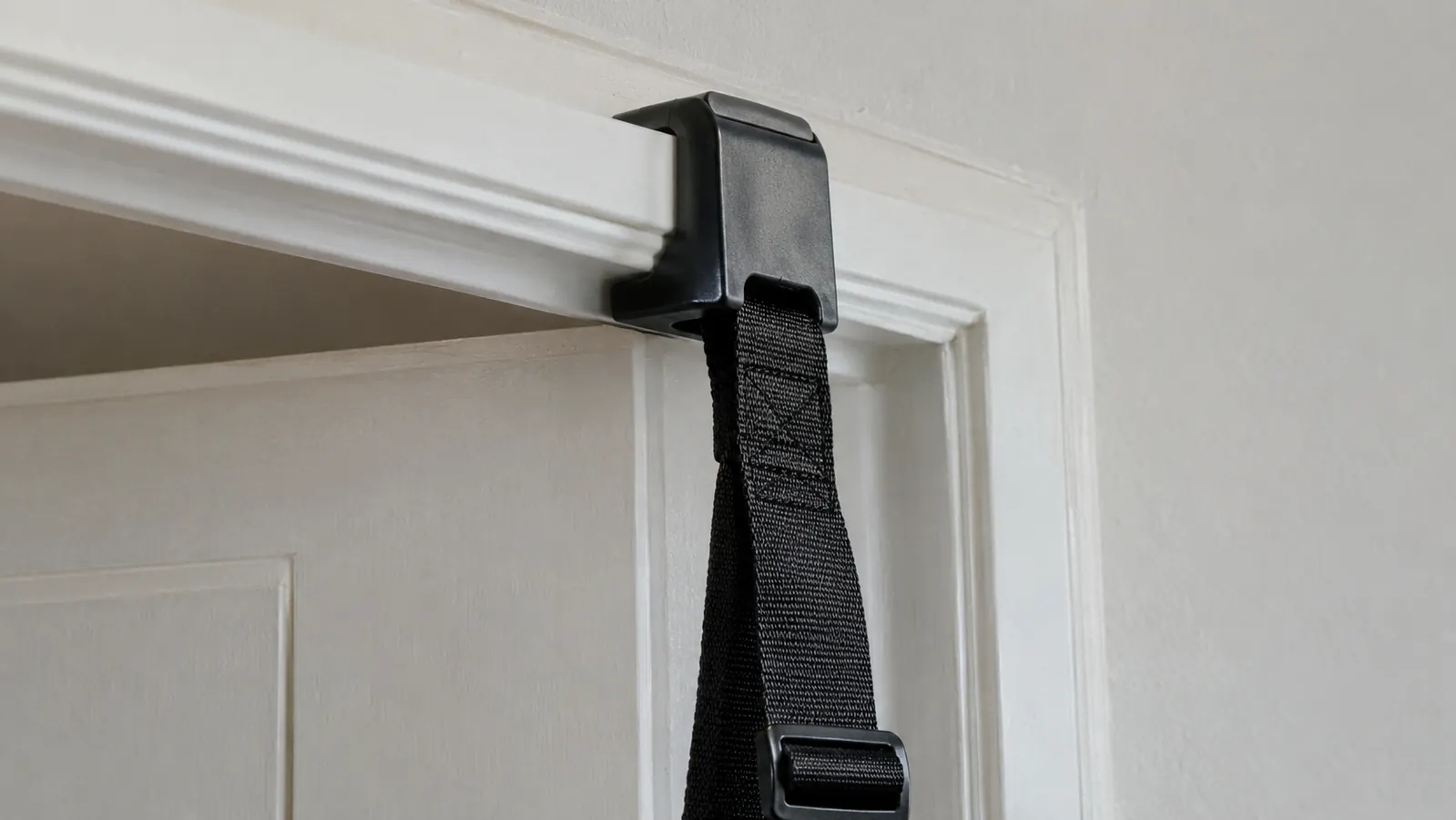
The door anchor is the piece I was most skeptical about. A strap with a wedge that jams into the top of a door frame sounds like something that would slip or tear up the paint. In practice it has been fine. I slide the wedge in, close the door, and the strap holds firm through chest presses and face pulls. I have used it on interior doors and the door leading into the garage, and it has not left a mark.
The handles are comfortable and the straps are long enough to double up for a shorter range of motion. The ankle straps wrap around and secure with velcro, and they stay put even when I am doing leg raises or kickbacks. The carabiners click in and out easily, which matters when you are switching exercises every few minutes.
One thing I did not expect: the bands are quiet. No clanking plates, no banging dumbbells. On mornings when Carmen is still asleep, I can run a full session without waking her up. That is a small thing, but it means I actually train on weekdays instead of waiting for a Saturday when the house is awake.
The only real setup complaint is the door anchor needs a door that closes flush. Our ranch house has a couple of doors that stick, and the anchor works better in the ones that close clean. That is a house problem, not a band problem, but it is worth knowing before you plan your whole workout around a door that does not quite close.
Training Around a Cranky Knee
I will be honest about the knee. A deep loaded squat is off the table, and I have made peace with that. The bands let me train legs without loading the joint. Banded squats, glute bridges with the ankle straps, and lateral walks with a band around my thighs all give me a burn without the ache the next day.
The resistance is smooth through the whole range of motion, which is the main advantage over a stack of weights. There is no sticking point at the bottom of a movement. The tension builds as the band stretches, so the hardest part of the rep is at the top, where your muscles are strongest. That matches the natural strength curve better than a dumbbell in a lot of movements.
I should also say the bands are easy on the elbows and shoulders. At my age, the joints complain about things they used to ignore. Band work lets me train around the knee without transferring the problem somewhere else. I have had no new aches from these sessions, and that is the best review I can give a piece of exercise equipment.
That does not mean the bands fixed my knee. Nothing has. They just let me train around it, and on the days my knee is angry, I can drop to a lighter band and still get a session in. That flexibility is the quiet reason these get used as much as they do.
Where the Set Comes Up Short
No review is honest without the cons, and this set has a few. The biggest one is that bands are not a linear progression tool. When I want to add weight, I jump from one band to the next, and the jump between the two heaviest bands is noticeable. There is no fine adjustment, so some sessions feel slightly too easy or slightly too hard.
The included bag is fine but basic, and after months of use the drawstring is starting to fray. The instruction booklet is thin, and if you do not already know a handful of exercises, you will want to look up videos. The carabiners feel lighter than the steel ones on a proper cable machine, and while mine have not broken, I treat them with a little more care.
One more honest note: the markings on the bands are starting to fade where they rub against the clips. It is still easy to tell them apart by feel, so it has not been a real problem, just something I noticed.
And if you are hoping to build serious, heavy muscle the way you would with a barbell, bands will only take you so far. For maintenance, general strength, and staying limber, they are plenty. For progressive overload into heavy territory, you will eventually want more. That is not a flaw in this set. That is just what bands are.
What I Liked
- Under a minute to set up, so it actually gets used at 5:45 in the morning
- Five resistance levels cover everything from light shoulder work to heavy rows
- Door anchor and ankle straps make it a full-body setup, not just an arm toy
- Bands held their tension through months of use and a hot garage summer
- Smooth resistance is easy on a cranky knee
Where It Falls Short
- The jump between the heaviest bands is steep, with no fine adjustment
- Lightweight clips and a basic bag, nothing premium
- Thin instructions, you will want to look up exercises
- Not a path to heavy progressive overload
After a full California summer in a hot garage and months of near-daily use, the bands still feel like they did on day one.
Who This Is For
This set is for the person who wants to train at home without turning their living space into a gym. If you have a corner of a room, a door that closes, and thirty minutes, these bands give you a genuine full-body session. It is for the person who is tired of paying for a gym they visit twice a month, or the person whose schedule does not allow a drive to the gym at 6 AM.
It is also for anyone with a joint that complains. I am not a doctor and this is not medical advice, but for me, band work has been the difference between training and not training. The low impact and smooth resistance make it easy to work around a sore knee or shoulder without making it worse.
For what it is worth, Carmen likes them too. She started with the lightest band and has worked her way up to the middle one. We do not train together much, but knowing the set works for both of us is a good sign that it is not tuned to one body type or one fitness level. It also means I cannot blame her when the lightest band is not where I left it.
This is also a good first piece of home gym equipment. If you are not sure whether you will actually train at home, a set of bands is a low-commitment way to find out. It is easy to store, easy to pack, and easy to sell if you decide it is not for you. I have seen too many people buy a treadmill that becomes a clothes rack. These bands do not have that problem.
Who Should Skip It
If you are chasing heavy progressive overload, if you want to bench press heavy or squat heavy again, this set will frustrate you. Bands cap out, and the jump between levels is too big for fine-tuned progression. You want a barbell or a good set of dumbbells.
And if you already own a full home gym, you do not need these. They are a complement, not a replacement. I still use my dumbbells and a pull-up bar. The bands are the most-used piece in the garage, but they are not the only piece.
One more group: if you want the feel of a real gym, the clank of plates and the chalk on your hands, bands will always feel like a compromise. That is a preference, not a criticism. Know what you want before you buy, and you will not be disappointed.
If you are still reading this and trying to decide, here is my honest bottom line. These bands will not turn you into an athlete. They will not replace a gym if you love a gym. But if you want something that fits in a corner, takes a minute to set up, and gets used, they are the best value in my garage. I reach for them three or four mornings a week, and I do not see that changing.
The set I reach for three mornings a week
If you are shopping for a set that will actually get used, the TheFitLife resistance bands are worth a look. See today's price and the full set details on Amazon.
Amazon Check Today's Price on Amazon →