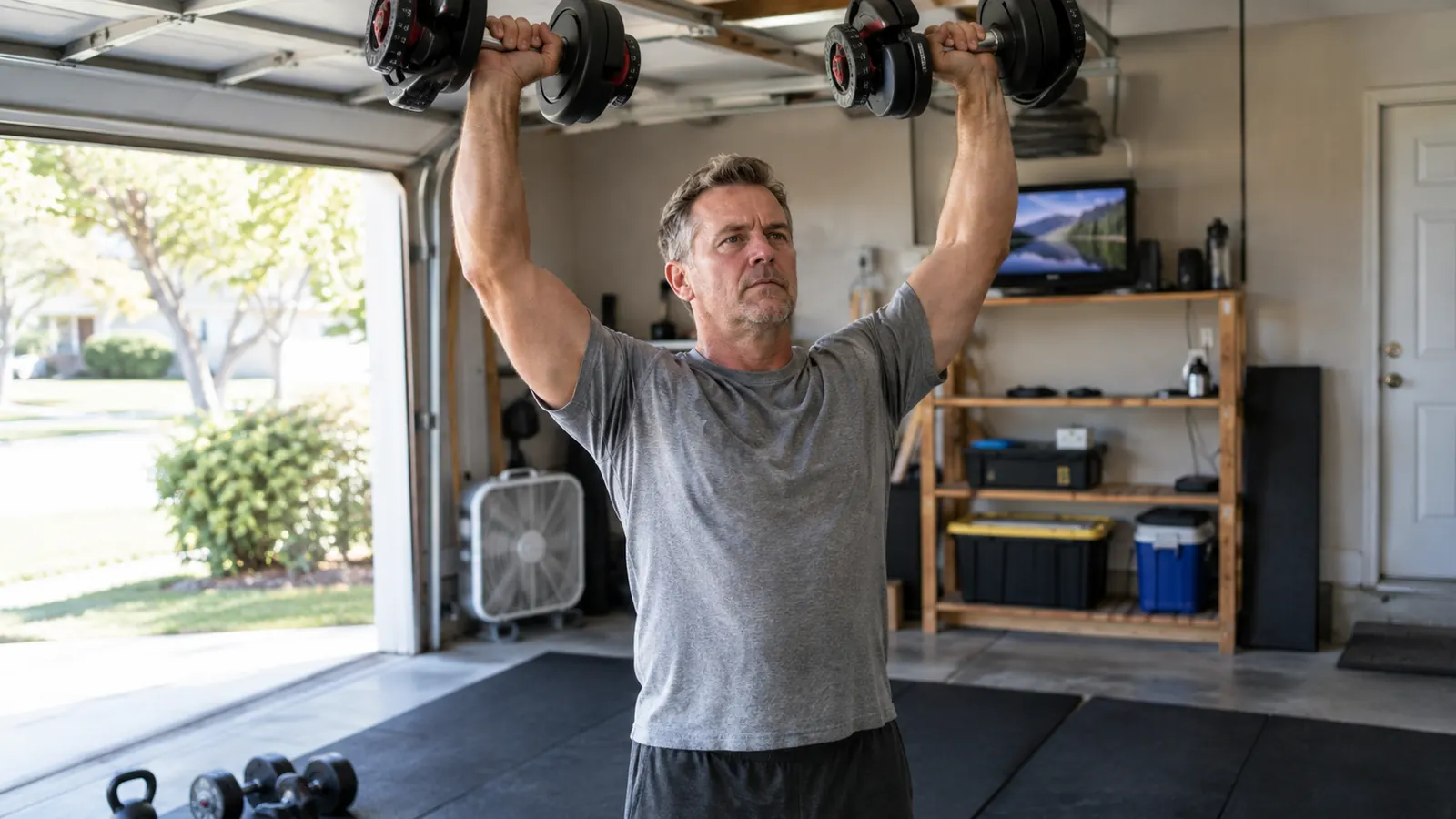
Six months ago I stood in the middle of my garage and counted the ways I had talked myself out of the gym. The round trip was forty minutes. The membership cost more than I actually used it. And at 51, with a left knee that has been cranky since a pickup basketball game in my forties, I did not want to drive anywhere to do exercises I could do at home. The problem was space. My garage is half workshop, half storage. There was no room for a rack of individual dumbbells, and I was not going to add one more piece of equipment that would end up leaning against the wall with the resistance bands I bought during the lockdown and used exactly twice.
That is what led me to the PowerBlock Elite EXP 90 set. Five months and roughly a hundred workouts later, I can tell you what it is like to live with adjustable dumbbells. Not what the listing promises. What it is actually like on a Tuesday morning, when I have about half an hour before I need to shower and get to work.
The Quick Verdict
The most practical pair of dumbbells for a garage that is also a storage room. Fast to change, small footprint, sturdy after months of use. The tradeoffs are a short learning curve and a blocky feel you have to adapt to.
Amazon Check Today's Price →The set I reach for three mornings a week
The PowerBlock Elite EXP 90 replaces 5 to 50 pounds per hand in a footprint smaller than a dorm fridge. If you are tired of paying for a gym you do not use, this is the version to look at first.
Amazon Check Today's Price on Amazon →How I've Used It
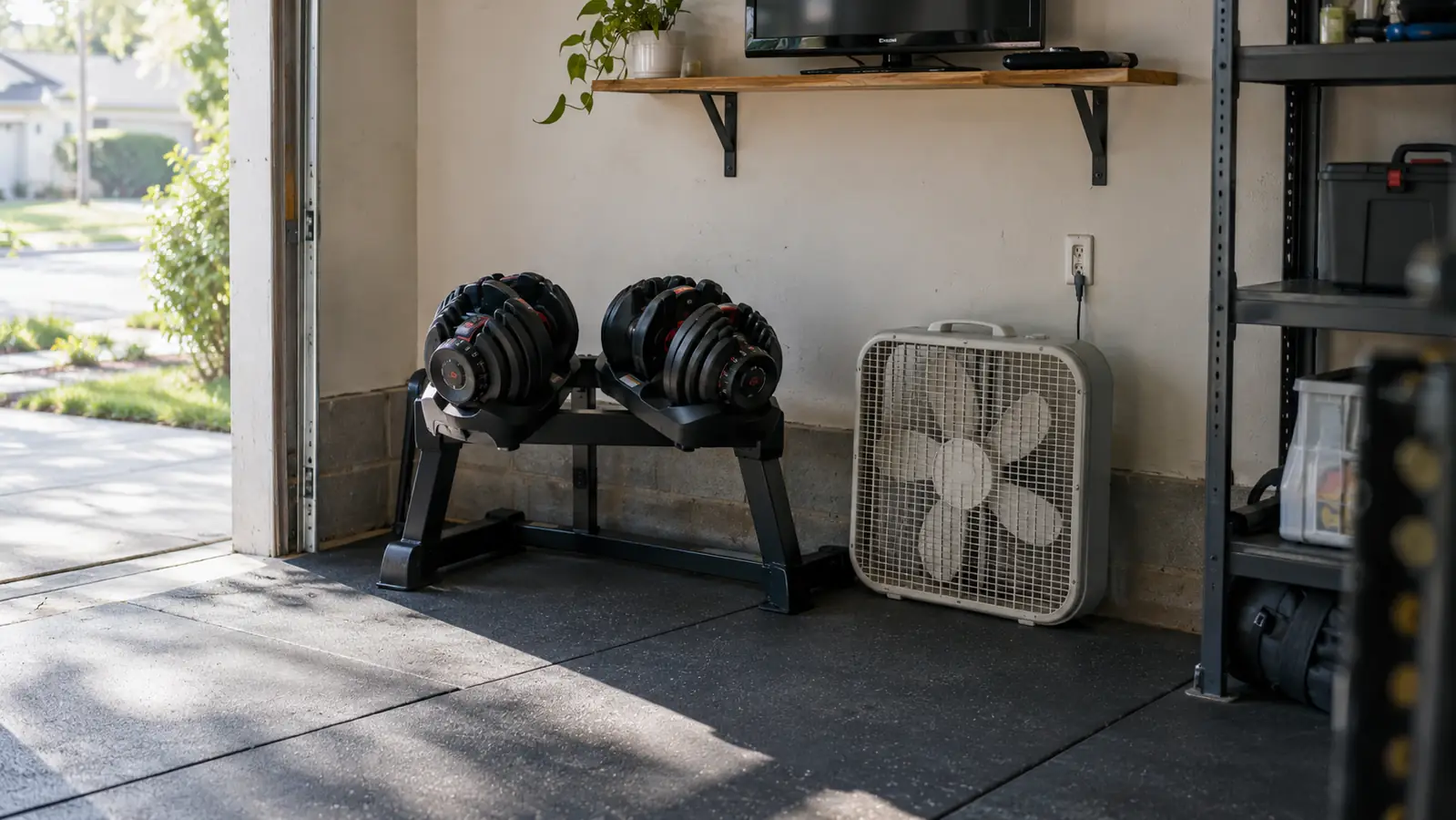
The setup is one half of a two-car garage. Rubber stall mats on the concrete, a box fan in the corner, a small TV on a shelf that I turn on for the morning news. The PowerBlock set lives on the floor against the wall, next to the lawnmower. When Carmen wants to use it, she moves it a few feet and goes to work. That is the whole story of its footprint. It takes up less space than the fan that keeps me cool while I lift.
I train three or four mornings a week before work, thirty to forty minutes, longer on Saturday. The routine is not fancy: overhead press, rows, curls, carries, and a few knee-friendly movements I picked up after my last basketball injury. With the PowerBlock set, I go from a warmup weight to a working weight in about fifteen seconds. That matters more than it sounds. When you have a minute between sets and you are already breathing hard, a fast change is the difference between doing the work and skipping it. I have owned equipment that made the workout harder to start. This one makes it easier.
On a Saturday, when I have more time, I do a longer circuit. Last Saturday I did five sets of overhead press at 40 pounds, four sets of rows at 45, three sets of curls at 30, and finished with carries at 40. Every change took one motion and about four seconds. The whole session, from first warmup set to last carry, was forty-one minutes. The weights get changed maybe fifteen times in forty-five minutes. With a rack of fixed dumbbells, that means walking back and forth to a rack. With the PowerBlock, it means reaching down, sliding the pin, and lifting. You spend your energy on the work, not on the logistics.
What the Elite EXP 90 Gives You
The headline number is 5 to 50 pounds per hand, in 5 pound jumps. That covers most of what a non-competitive person needs from a home gym. I am 51 years old and I do not consider myself strong. Fifty pounds per hand is still enough for my presses, my rows, and everything else in my rotation. The EXP in the name means expandable. If I ever get strong enough that 50 stops being enough, PowerBlock sells expansion kits that take the set higher. I have not needed them. It is good to know they exist.
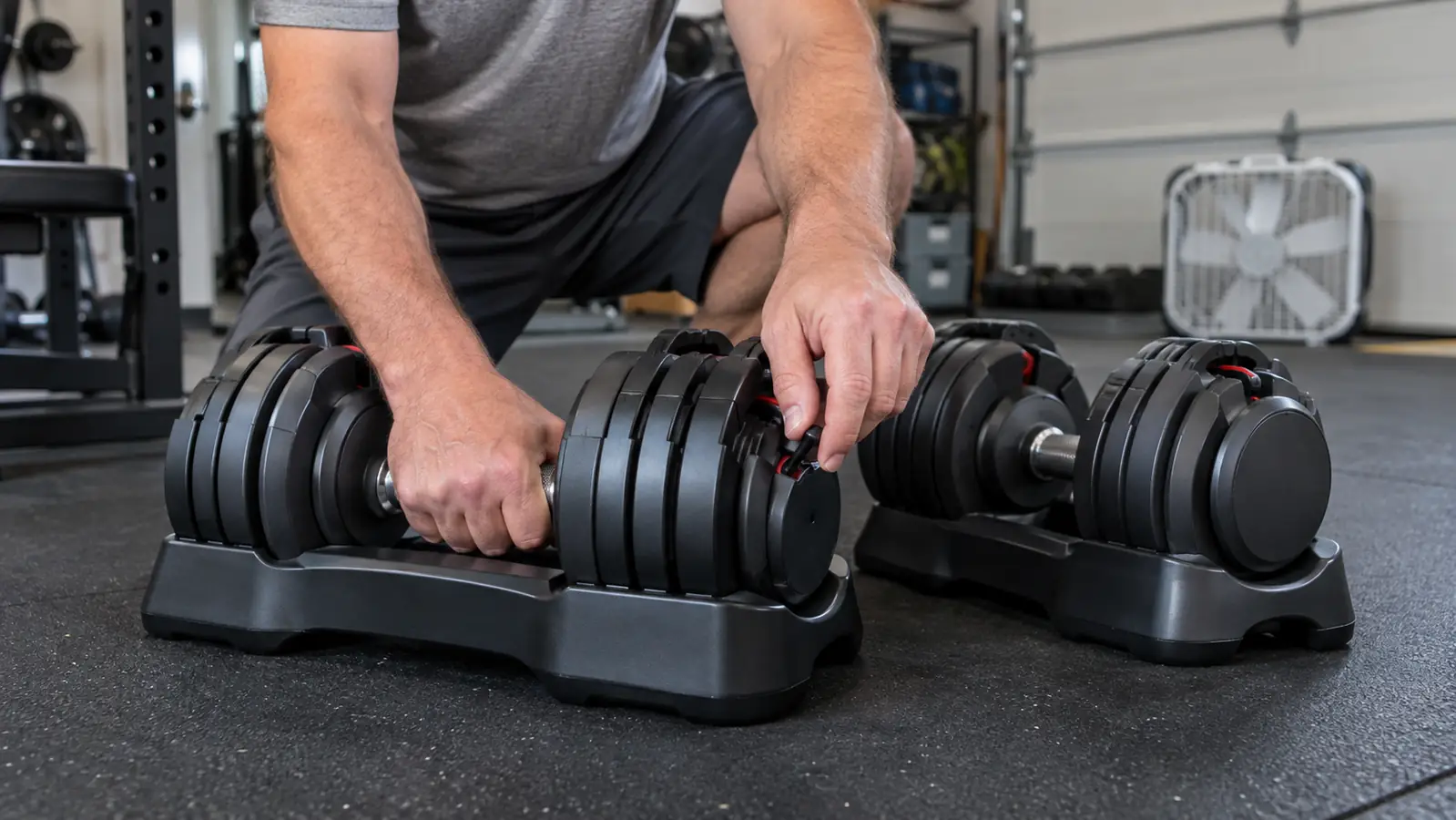
The change mechanism is a selector pin. Slide the pin into the weight you want, lift the handle, and the plates you do not need stay on the base. It takes about four seconds once you have done it a few times. There is no dial to turn, no collars to tighten, no loose plates to stack. The pin clicks into place and the plates lock onto the handle. After months of use, the pins on mine still click in cleanly every time.
The footprint is the part that sold me. The whole set sits on a base roughly the size of a small cooler. It leans against the wall in my garage and takes up less floor space than the box fan. For anyone whose home gym is actually a corner of a room that has other jobs, that footprint is the whole point. It is why I can have a real set of dumbbells and still park both cars in the garage.
Carmen uses them too, mostly for lighter work and core exercises. That is one of the quiet advantages of an adjustable set. Two people with very different strength levels share the same two handles. She sets the pin at 15, I set it at 40, and neither of us touches the other's weights. A fixed set would need two of everything, or one of us would be stuck using the wrong weight.
Months In: What Holds Up and What Doesn't
I have used this set roughly a hundred times in five months. The plates are solid steel, and the finish looks as good now as it did on day one. I have dropped the handles from waist height a few times onto the rubber mats. Not once has a plate come loose or a pin bent. I would not go out of my way to drop them, but they have taken the bumps that real life hands out. The welds are clean, the edges are consistent, and nothing has worked itself loose.
The handle grip is comfortable for normal sets. The knurling is not aggressive, which I prefer. It is smooth enough that I do not need chalk, and grippy enough that I do not think about my hands slipping. After a long set of farmer's carries, my palms feel fine. That was one of my worries, and it has not been a problem. The handle diameter is a middle ground that suits my hands, and Carmen has not complained about it either.
The one thing that has changed is my confidence in the locking mechanism. Early on, I double checked the pin every time I lifted. Now I check it once and trust it. The mechanism has not failed once in five months. I still do not swing the weights around or do anything jerky with them, but I stopped being precious about the set a long time ago. It is a tool now, not a new purchase I am still nervous about.
The Tradeoffs Nobody Puts in the Listing
Here is the honest part. The plates are blocky, not round, and on exercises where you rest a dumbbell on your thigh to get it into position, like a chest press, the flat edges dig in a little. You learn to adjust. You set the weight on your leg at a slightly different angle, or you use your other hand to help it up. It is a minor thing, but it is real, and nobody mentions it in the product photos. If you do a lot of work that involves resting the dumbbell on your body, you will notice it.
The other tradeoff is the learning curve. The first few sessions, the change mechanism feels fiddly because you have not built the muscle memory. You have to look at the pin, check the number, and make sure the plates are locked. By the end of the first week it is automatic. Anyone who tells you these are as intuitive as a normal dumbbell from day one is not being honest. Give yourself three or four sessions and it stops being a thought.
Two more small things. The handle is a bit short for exercises where you normally hold a dumbbell with both hands, like a goblet squat. You can do them, but it is tighter than with a standard dumbbell. And these are not weights you want to drop from overhead. If your training style involves slamming or dropping weights, buy something built for that abuse. This set is built for controlled work, and it rewards people who train that way.
The Small Stuff: Noise, Maintenance, and Daily Life
Noise matters in a house. This set is quiet in a way I did not expect. The plates are held by the pin, so they do not rattle when you carry them. There is a solid click when the pin seats, and then nothing. When I train early in the morning, Carmen sleeps through the whole session. That alone was worth the switch from the clanging dumbbells at the gym.
Maintenance has been zero. I wipe the handles down after a sweaty session and I have never oiled the pin or adjusted anything. The instructions say to store them on the base with the pin in place, and I do. That is the entire care routine. Five months in, everything still moves the way it did on day one. I cannot ask for more than that from a piece of equipment I use three or four times a week.
The one habit I had to build was putting the pin back in the base when I finish. The pin is small, and it is easy to set it down on a shelf and then hunt for it the next morning. I keep it in the base now, every time. That is the closest thing to a complaint I have about the daily routine.
How It Compares to the Alternatives I Considered
Before I bought the PowerBlock, I went back and forth on three options. The first was a full rack of fixed dumbbells. That is the nicest thing to use, and the most honest way to train. It also takes up a wall of space and costs more than my whole garage setup. For someone with a dedicated gym room, it is the right answer. For me, it was never practical. I park a car in my garage, and I like being able to open the door without moving weights.
The second was a dial-style adjustable set, like the Bowflex SelectTech line. Those are good products, and the dial is genuinely easy to use. My reason for not choosing one is that the cradle takes up more room, and the change mechanism has more parts to wear out. The PowerBlock is simpler. Fewer moving pieces, fewer things to break. I have had the same set for five months and the mechanism has not needed any attention. I like that in a tool.
The third option was just using kettlebells and calling it a day. That works for some people. I found that a single kettlebell does not cover the range of movements I actually want to do, and buying several kettlebells starts to cost as much as an adjustable set. The PowerBlock covered the most ground for the space it takes up, which is why it won. If I had to buy again tomorrow, I would make the same choice. That is the highest praise I can give a piece of equipment.
What I Liked
- 5 to 50 pounds per hand in one compact pair
- Weight changes take about four seconds with the selector pin
- Small footprint that fits a shared garage corner
- Expandable later if 50 pounds stops being enough
- Solid build that has held up to about a hundred workouts
- Two people with different strength levels can share one set
Where It Falls Short
- Blocky plates dig into your thighs on some exercises
- Short learning curve before the change feels natural
- Handle is tight for two-hand moves like goblet squats
- Not built for dropping or slamming weights
A hundred workouts in, not one stuck pin, not one loose plate, not one set I skipped because changing the weight took too long.
Who This Is For
The PowerBlock Elite EXP 90 is for people whose home gym is actually the corner of a room that has other jobs. It is for the person who trains before work, has thirty minutes, and does not want to spend five of them changing weights. It is for the couple with different strength levels who want to share one set. It is for anyone who has paid for a gym membership, used it for a month, and is tired of paying for something they do not use.
If that sounds like you, the adjustment period is short and the payoff is real. I get three or four honest workouts a week out of a pair of dumbbells that live next to my lawnmower. Five months in, I still look forward to the Saturday morning sessions. That is more than I could say for any gym membership I have ever had. The gear does not make you train. But it can remove every excuse you have been using.
One more thing. I am not a strong guy, and I am not a young guy. If this set works for me, it will work for most people who train at home for practical reasons. The weights go heavy enough to challenge me, and light enough that Carmen can use them for her own routine. That range is the product.
Who Should Skip It
You should skip the PowerBlock if you are a serious lifter who needs more than 50 pounds per hand right now. The expansion kits exist, but you will be buying a base set plus upgrades, and at some point a real rack of plates starts to make more sense. You should also skip it if you train with aggressive drops, slams, or throws. These are precise tools for controlled movement, not crash-test weights.
And if you are someone who buys equipment and then does not use it, no dumbbell will fix that. I am not selling a shortcut. I am saying that when I cleared the excuses out of the way, this was the piece of gear that actually got used. If you are honest with yourself about whether you will train, this set will meet you more than halfway. That is the whole review.
The dumbbells that actually get used
Five months in, the PowerBlock Elite EXP 90 is still the first thing I reach for on a training morning. If you are weighing a gym membership against a corner of your garage, check the current price on Amazon and decide for yourself. For me, the decision was easy.
Amazon Check Today's Price on Amazon →