For a guy who spent twenty years in logistics, my own daily step count is embarrassingly low. I sit at a desk, I drive a route, I sit at a desk again. My left knee has been cranky since my pickup basketball days, so my options for fixing the step count felt limited. The gym is a thirty-minute round trip I do not always have in me before work. Walking outside is fine until it's ninety degrees or raining. And a full-size treadmill would eat half my garage, which is already half gym, half storage.
That's why I ordered a Viamotion walking pad last fall. I wanted something compact enough to live against the wall, quiet enough to use while Carmen watched TV, and simple enough that I would actually use it at 6:30 in the morning. Eight months later, it's still in the rotation, three or four mornings a week. This is the long-term review I wish I'd read before I bought it.
The Quick Verdict
A sturdy walking pad with a genuinely useful incline and a handle bar that makes it feel safer than I expected. It won't make you run, but it will get you walking most days, which is the whole point.
Amazon Check Today's Price →The walking pad I still use eight months later
If you're comparing compact treadmills for a small space, here's what living with the Viamotion actually looks like, the good and the tradeoffs.
Amazon Check Today's Price on Amazon →How I've Used It
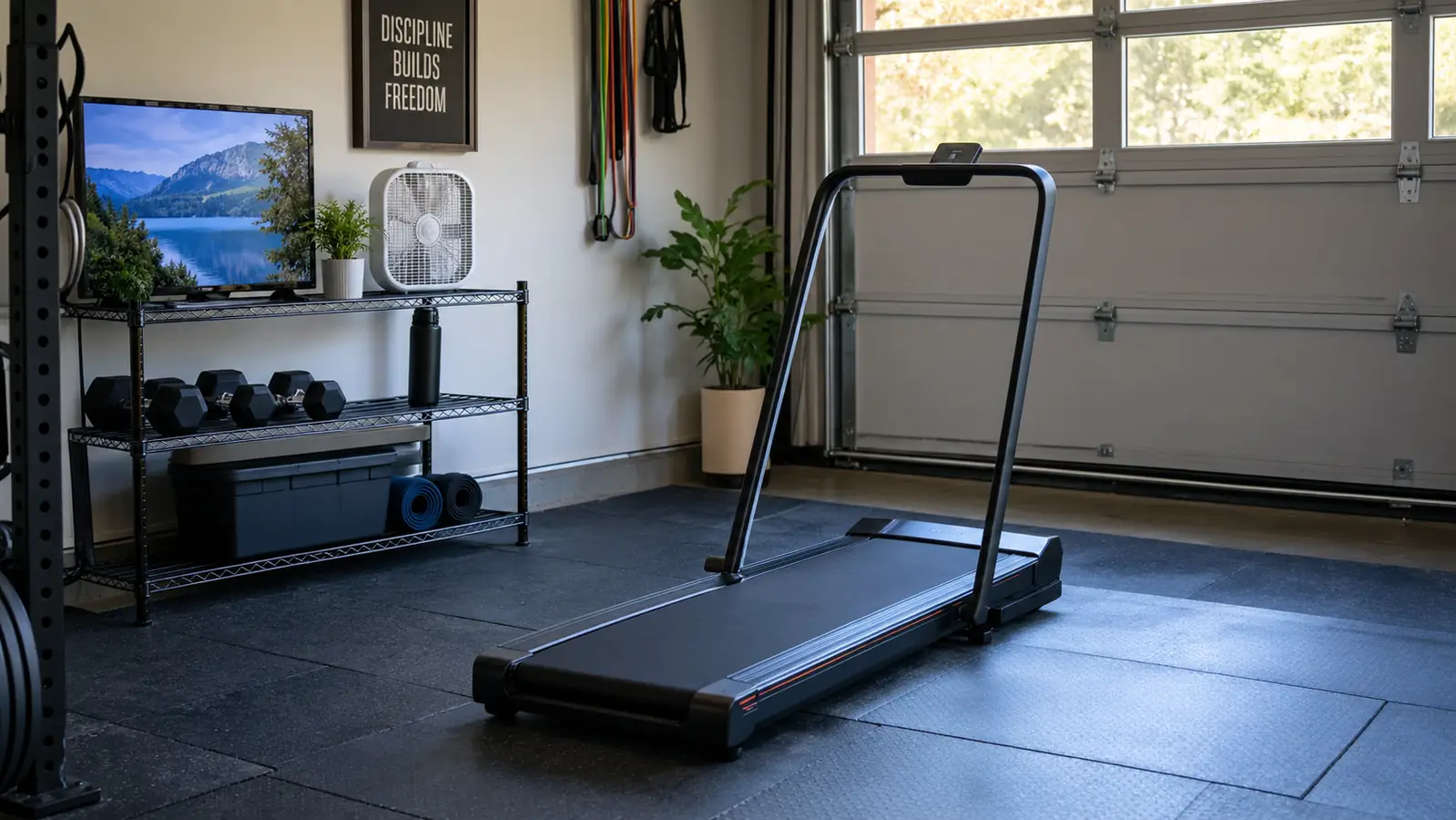
My setup is simple: one half of a two-car garage, rubber stall mats on the floor, a box fan in the corner, and a small TV on a shelf. The Viamotion lives on the mats next to the wall, out of the way but never packed away. On a normal week I walk Monday, Wednesday, Friday, and Saturday morning, about thirty to forty minutes before work. Carmen uses it too, usually fifteen minutes after dinner while she watches a show.
The routine took about a week to become a habit, and that's the real test for any piece of home gym gear. The pad is out and ready, so I don't have to clear space, drag anything around, or talk myself into a drive to the gym. I put on shoes, step on, set the speed, and walk. The friction is gone, and for me, friction was the whole problem.
I use the incline more than I expected. On easy days I keep it flat and just get the steps in. On days when I want to actually work, I bump it to a low incline for twenty minutes and I feel it in my legs and my breathing without feeling it in my knee. That's the balance I've been looking for since my knee started complaining.
The routine matters more than the machine. I keep a pair of shoes by the pad, I put on a show I only watch while walking, and I tell myself I only have to do ten minutes. Ten minutes usually becomes thirty. That's how a walking pad earns its floor space.
Setup and Footprint
The box is heavy but manageable for one person. I slid it into the garage, opened it on the stall mats, and had it ready to walk in maybe twenty minutes. The main unit needed no tools. The handle bar took a few bolts and about ten of those minutes. Nothing about the process was confusing, and I did not have to call anyone for help.
Footprint is the reason most people look at walking pads, and this one delivers. It takes up a slice of the garage floor that used to hold a stack of bins. When I'm walking, there's still room to walk past it. When I'm not, it just sits there, ready. For an apartment, a spare room, or an office corner, that's the whole appeal: you are not rearranging your life to make room for it.
One note on placement: I put mine on the stall mats, and I'm glad I did. The mats dampen the sound and give me a stable surface. If you're putting yours on a hard floor, I'd at least use a mat underneath. It's a small thing, but it makes the whole setup feel more solid.
What It's Like to Walk On
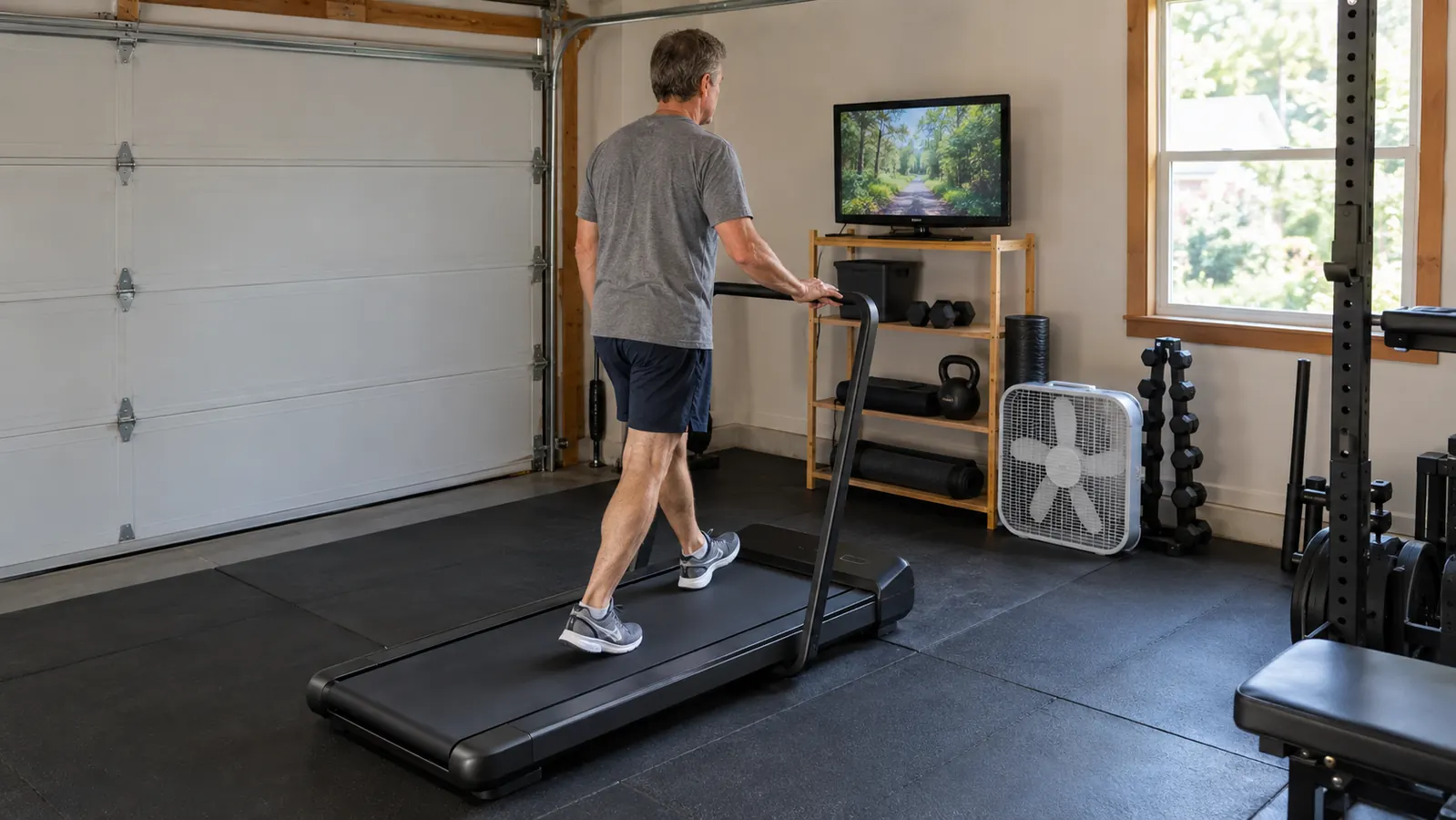
The walking surface is narrower than a gym treadmill, which took me two or three sessions to get used to. Once I stopped looking at my feet, it stopped being an issue. The belt is smooth, and the motor is quiet enough that I can hear the TV at a normal volume. Not silent. There's a hum, and the belt makes a soft sound underfoot. But my wife can sleep in the room next to the garage, which tells you something.
The handle bar is the feature I underestimated the most. I grab it when I step on and off, and I hold it when I'm adjusting the speed or the incline mid-walk. It also gives me somewhere to rest my hands when I'm walking at a good clip. It's not a treadmill console with heart rate grips and a fan. It's a bar. That's all I need it to be.
As for speed, I walk mostly between 2.5 and 3 miles an hour. There's room above that, but honestly, a walking pad is for walking. If you want to run intervals, this is not the tool. The incline is where the work happens. At a low setting, a twenty-minute walk feels like something. I notice it in my calves and my breathing, and I don't notice it in my knee.
I've been careful with deep loaded squats since my knee started acting up, so I was nervous about anything that put weight through my joints. Walking on a flat belt was fine, but the incline worried me. Turns out the low incline is gentle. The movement is smooth, the pace is slow, and there's no impact. It's the closest thing to a safe workout I've found that still feels like work.
Noise, Stability, and the Long-Term Verdict
Eight months in, the Viamotion still feels solid. No wobble at walking speed, no squeaks, no belt drift that I've noticed. I wipe the deck down when I've sweated on it, and I don't do anything else. It starts every time, which sounds like a low bar until you've owned gear that doesn't.
The noise question is the one everybody asks, so here's the honest answer. It's not silent. On a quiet morning I can hear the motor hum and the belt moving underfoot. But it's the kind of sound that disappears once a show is on. I've walked while Carmen watched something a few feet away, and she never once asked me to turn it down.
My knee's verdict is the one I care about most. After a walk on the Viamotion, my left knee feels better than it does after a day at my desk. That's not a medical claim, it's just my experience. Low impact, easy pace, no pounding. For a guy who used to jump for rebounds, that's exactly the kind of exercise I can actually stick with. If you want the longer version of why a walking pad is easier on knees than most cardio, there's a separate article on exactly that.
I also appreciate that there's no app to fight with. Some gear in my garage has a companion app that needs updates and accounts and permissions. The Viamotion has a simple way to control speed and incline, and that's it. At 6:30 in the morning, that's a feature.
Alternatives I Considered
Before I bought the Viamotion, I looked at the cheap walking pads with no incline and no handle bar. They were tempting, but I'm glad I didn't go that route. The incline is the difference between a flat shuffle and an actual workout. On a flat belt, I would have gotten bored in a month. With a low incline to work against, the same walk keeps my attention and keeps my legs honest.
I also thought about a full-size treadmill, and I'm glad I didn't do that either. A treadmill with a console and a deck that folds still takes up a lot of room, and it's heavier, louder, and more to maintain. The Viamotion is the middle path: it's a real piece of equipment, not a toy, but it doesn't demand a dedicated room.
If you're deciding between a few walking pads, the things I'd compare are the incline range, the handle bar, and the belt width. Those are the details that show up in daily use. The Viamotion got all three right for me, and that's why it's the one that stayed in the garage.
I put together a full side-by-side comparison of the Viamotion and a Urevo walking pad, and the short version is that the Viamotion won on the things I actually feel during a walk: the incline, the handle bar, and the stable belt. If you're torn between two models, that's the article to read.
If You're Putting It in a Spare Room
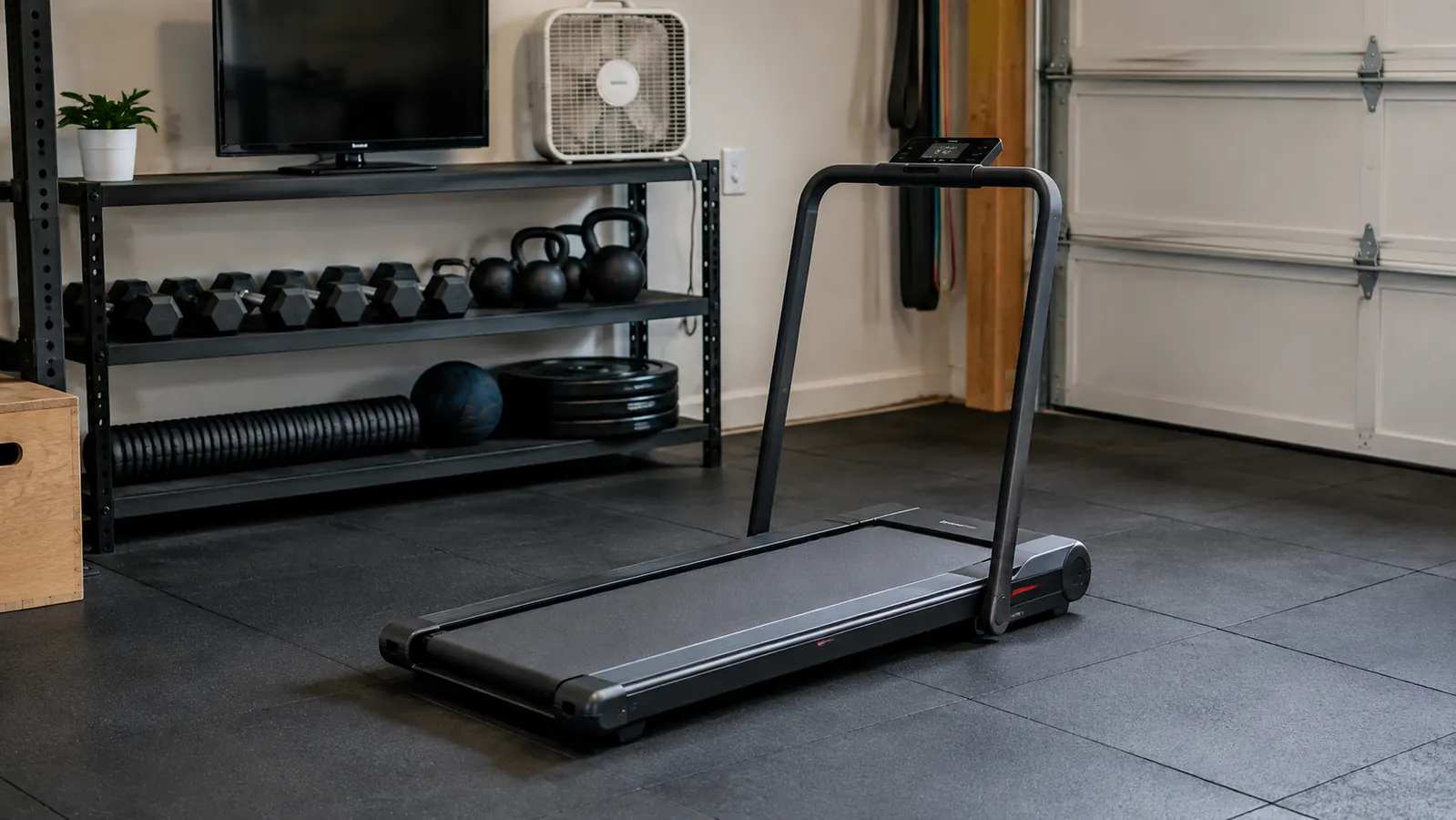
My Viamotion lives in the garage, but the reasons I bought it are the same reasons someone would put one in a spare room or an office. It doesn't need ventilation, it doesn't need a dedicated circuit, and it doesn't need a mat, though a mat helps. It needs about the same floor space as an armchair, and it doesn't complain when you walk in front of the TV.
The one thing I'd say about a spare room or bedroom is the sound. The Viamotion is quiet enough for a garage and quiet enough for a room, but it is not silent. If you plan to walk while someone else is trying to sleep in the next room, keep the speed moderate and put a mat underneath. That's the setup that works in my house.
If the pad is going in a room you also use for work, I'd set it up facing away from your desk. You want the walk to feel like a break, not like more work. A spare room with a TV or a window is ideal.
What I'd Change
No product is perfect, and this one has three things I'd flag. First, it's a walker, not a runner. If you're hoping to jog on it, you will be disappointed. Second, the walking surface is narrower than a full treadmill, so the first few sessions take some attention. Third, you bring your own entertainment. There's no big screen and no preset workouts. It's a motor, a belt, and a handle bar.
None of those are dealbreakers for me. The narrow belt became normal by week two. The lack of a screen means I watch my own shows on the little TV. And the speed ceiling just means I do my harder work elsewhere. But I'd rather tell you now than have you find out after you've bought one.
One small thing: the box is heavy. If you're buying this for someone who can't lift forty or fifty pounds, have them open it with help. Not a dealbreaker, just a heads up.
What I Liked
- Small footprint that fits a spare room, a garage, or an apartment corner
- Quiet enough to watch TV at a normal volume while you walk
- The incline adds real work without stressing a sore knee
- The handle bar makes stepping on and off feel secure
- Simple controls, no app, no account, no updates
- Still solid after eight months of regular use
Where It Falls Short
- It's for walking, not running or jogging
- The walking surface is narrower than a full-size treadmill
- No built-in screen or workout programs; you supply the entertainment
- The box is heavy and the handle bar takes a few minutes to attach
Eight months in, three or four mornings a week, and my knee still feels better after a walk than it does after a day at my desk.
Who This Is For
This is for anyone whose problem is friction, not motivation. If you want to move more but the gym is too far, the weather is too unreliable, or the idea of a full treadmill makes you laugh, a walking pad like this removes the excuses. It's for desk workers, for people with cranky joints, for parents who can only grab twenty minutes, and for anyone who would rather walk in a t-shirt than drive to a gym in one. If that sounds like you, the Viamotion is worth a serious look.
It's also for people who already have a workout routine and just want more daily movement. I still lift weights in the garage. The walking pad isn't my workout, it's my baseline. It's the thing that makes sure I'm not going from the bed to the desk to the couch.
Who Should Skip It
Skip it if you want to run. Skip it if you need a full workout console with programs, heart rate monitoring, and a fan. Skip it if you expect gym-treadmill stability from a compact walking pad. And be honest with yourself: if you already own a treadmill that works as a clothes rack, a walking pad will probably become a very expensive place to put laundry. This thing only works if you actually step on it.
The best walking pad is the one you actually use
After eight months, the Viamotion is the piece of gear in my garage that gets used most. If that's the outcome you're after, check today's price on Amazon.
Amazon Check Today's Price on Amazon →