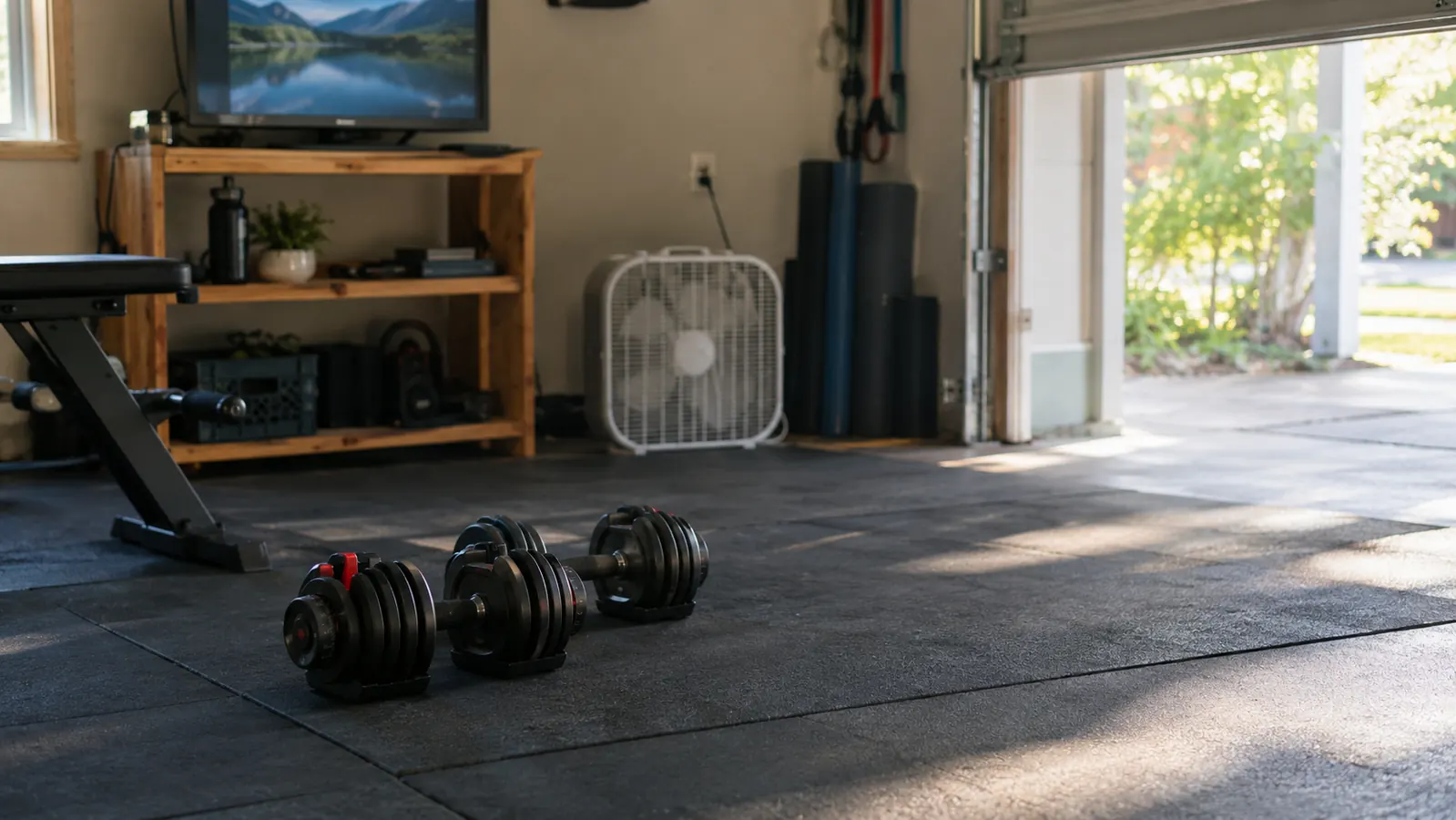
I have a cranky left knee, about 30 minutes most mornings, and half a two-car garage to train in. That combination rules out a lot of the equipment people post online. I am not going to be doing heavy barbell squats at 5:45 AM, and I am not going to store a machine that takes up half my stall mats. So when I finally got tired of my mismatched dumbbells, a pair of tens, a pair of twenties, and one lonely 25 with a chipped plate, I narrowed the search to the two names everyone mentions: PowerBlock and Bowflex SelectTech. I ordered the PowerBlock Elite EXP 90 set first, used it for a month, then spent a month with the Bowflex SelectTech, and then put one of them back in the box. The short answer is that PowerBlock wins for how I train, and probably for how you train too, but the Bowflex does a couple of things genuinely better and I will tell you exactly what they are. If you are short on time, here is the whole review in one line: one of these changes weight in seconds and stores on a shelf, the other feels like a classic dumbbell but eats floor space and minutes.
I did not do anything scientific. I trained three or four mornings a week, 30 to 40 minutes a session, the way I always do. Some days were a full body circuit: rows, presses, curls, split squats, lateral raises. Some days were shorter, just arms and shoulders before work. I kept a notebook in the garage, the same spiral notebook I use for everything, and I wrote down how long each weight change took, whether the handle bothered me, and whether I actually wanted to use the set the next morning. That last part matters more than any spec sheet. I also paid attention to the small stuff: how much noise each set made at 6 AM, whether the weights wobbled on the handle, whether I had to bend over to change them, and whether Carmen reached for one set more than the other. After four weeks with the PowerBlock Elite EXP 90 and four weeks with the Bowflex SelectTech, I had a clear answer about which one earned the floor space.
| PowerBlock Elite EXP 90 | Bowflex SelectTech | |
|---|---|---|
| Weight change speed | A few seconds with one pin | Turn two dials, several seconds per side |
| Footprint | Two compact blocks that store on a shelf | Two larger units that need a cradle and floor space |
| Feel in the hand | Blocky, took me about a week to get used to | Round handle, very close to a classic dumbbell |
| Weight range | 5 to 50 lb per hand, expandable later | 5 to 52.5 lb per hand, smaller increments |
| Noise | Metal clack when plates engage | Quieter, mostly plastic clicks |
| Drop tolerance | Not meant for heavy drops, treat them with care | Cradle can crack if you drop the weight hard |
| Best for | Short workouts, small spaces, quick changes | People who want a classic feel and don't mind slower changes |
| Learning curve | About a week to get used to the blocky handle | Familiar right away, like a classic dumbbell |
| Expansion | Add-on kits take it past 50 lb per hand | No expansion path |
| Adjustment mechanism | One pin, hard to misread | Two dials, need to count clicks |
Where PowerBlock Wins
The big one is speed, and speed is not a small thing when you have 30 minutes. With the PowerBlock Elite EXP 90, I slide one pin out, turn the handle, and the plates drop into the new setting in about three seconds. On a morning when I am moving from curls to rows to overhead presses, that speed keeps my heart rate up and my rest periods honest. I timed myself one Tuesday in March: a circuit of ten exercises, fourteen weight changes total, and every single change took less than five seconds. With the Bowflex, I had to stop, set the dumbbell down, turn a dial on each side, count the clicks, pick the weight back up, and get back into position. It does not sound like much, but over a full circuit it added minutes, and minutes are exactly what I do not have before work.
The other PowerBlock win is storage. The Elite EXP 90 set is two compact blocks that sit on a shelf in my garage. I put mine on a wooden shelf above the box fan, and the whole setup takes up almost no floor space. The middle of my stall mats stays open for split squats and for Carmen's yoga mat when she uses the garage a couple of times a week. The Bowflex cradles are bulky and want to live on the floor, which means they take up about two feet by four feet of my limited space. In a garage that also holds a box fan, a small TV, and a shelf of old running shoes, floor space is the thing I actually ran out of. PowerBlock also has an expansion kit if I ever want to go past 50 lb per hand, and the Bowflex does not offer anything like that.
One more thing in PowerBlock's favor: the change is harder to mess up. With the Bowflex, if I turned the dial one click too far or missed a click, I would sometimes grab the dumbbell and feel it shift mid-rep. That happened twice in the first week, once on a set of curls and once on a set of rows. The PowerBlock pin either seats or it does not, and when it is seated, the weight is locked. For a guy who is half awake at 5:45 AM, a locking mechanism that does not ask me to count clicks is worth a lot.
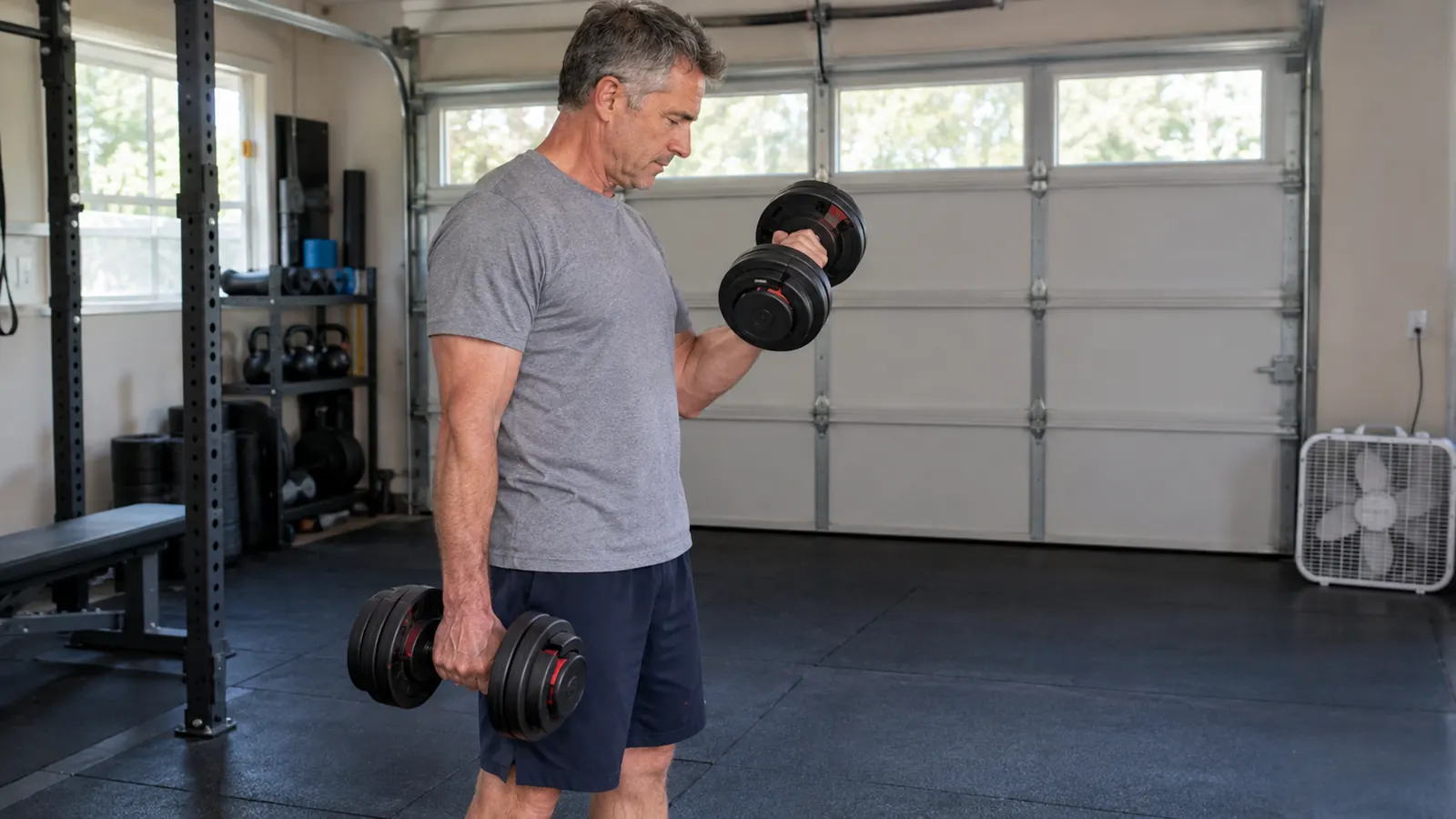
I will say this for the PowerBlock's learning curve: it is shorter than I expected. The first Monday, I fumbled the pin twice and dropped the handle once, but by Wednesday I could change weight without looking. The handle is square, and the plates are arranged in a block around it, so the center of gravity sits differently than a cast iron dumbbell. It took me a few sessions to stop overcorrecting on presses. What helped was doing a slow warm-up set with the empty handle first, just to feel where the weight sat. After about eight sessions, the blocky feel disappeared and I stopped thinking about the equipment entirely, which is exactly what you want from a tool.
Where Bowflex SelectTech Wins
I will be straight with you: the Bowflex feels better in the hand. The handle is round, the weight distribution is familiar, and it behaves like a normal dumbbell that happens to have a dial. The PowerBlock took me about a week to stop noticing the square handle and the blocky shape. The first few sessions, the edge of the block caught my thigh on curls and made me adjust my grip on presses. If you have spent years with classic dumbbells and hate changing things up, the Bowflex is the easier transition. Carmen, who uses the garage a couple times a week, said the same thing without me asking. She picked up the Bowflex, did a few curls, and said this one feels like a real dumbbell. I knew exactly what she meant.
The Bowflex also wins on smaller increments. It goes up in 2.5 lb steps, while the PowerBlock Elite EXP 90 jumps in 5 lb steps in the lower range. For exercises like lateral raises or rear delt work, 5 lb can be the difference between too light and too heavy. I remember one Saturday morning doing lateral raises at 15 lb with the PowerBlock, struggling through the last few reps, and thinking that 12.5 lb would have been perfect. The Bowflex would have given me that option. If your training is built around isolation work where a couple of pounds matter, that finer control is a real advantage and I do not want to wave it away.
The Bowflex is quieter too. The PowerBlock makes a metallic clack when the plates engage, which is fine at 6 AM in a detached garage, but if you train near a bedroom or an apartment wall, the Bowflex is the more polite neighbor. Its adjustments are mostly plastic clicks and the weights do not rattle the same way. I did not think noise would matter to me until the morning I dropped a 40 lb PowerBlock on the stall mat from about six inches up, just fumbled the grip on a renegade row, and the clang echoed through the whole garage. Nothing broke, and the mats took it fine, but it reminded me that these are precision pieces of equipment, not iron plates you can throw around.
The Bowflex dials are clever, but they ask more of you than the PowerBlock pin. To go from 20 to 25 lb, I had to set the dumbbell down, turn the left dial two clicks, turn the right dial two clicks, pick it up, and give it a small shake to make sure the plates were seated. If I missed a click, the handle would spin freely for a second before locking in. I also found that the cradles need to be on a flat surface; on my stall mats, one cradle rocked slightly until I slid a thin piece of cardboard under a corner. It is not a deal breaker, but it is the kind of fussiness you should know about before you buy.
Want the dumbbell that changes weight fastest?
The PowerBlock Elite EXP 90 swaps weights in seconds and stores on a shelf. Check today's price on Amazon and see if it fits your garage.
Amazon Check Today's Price on Amazon →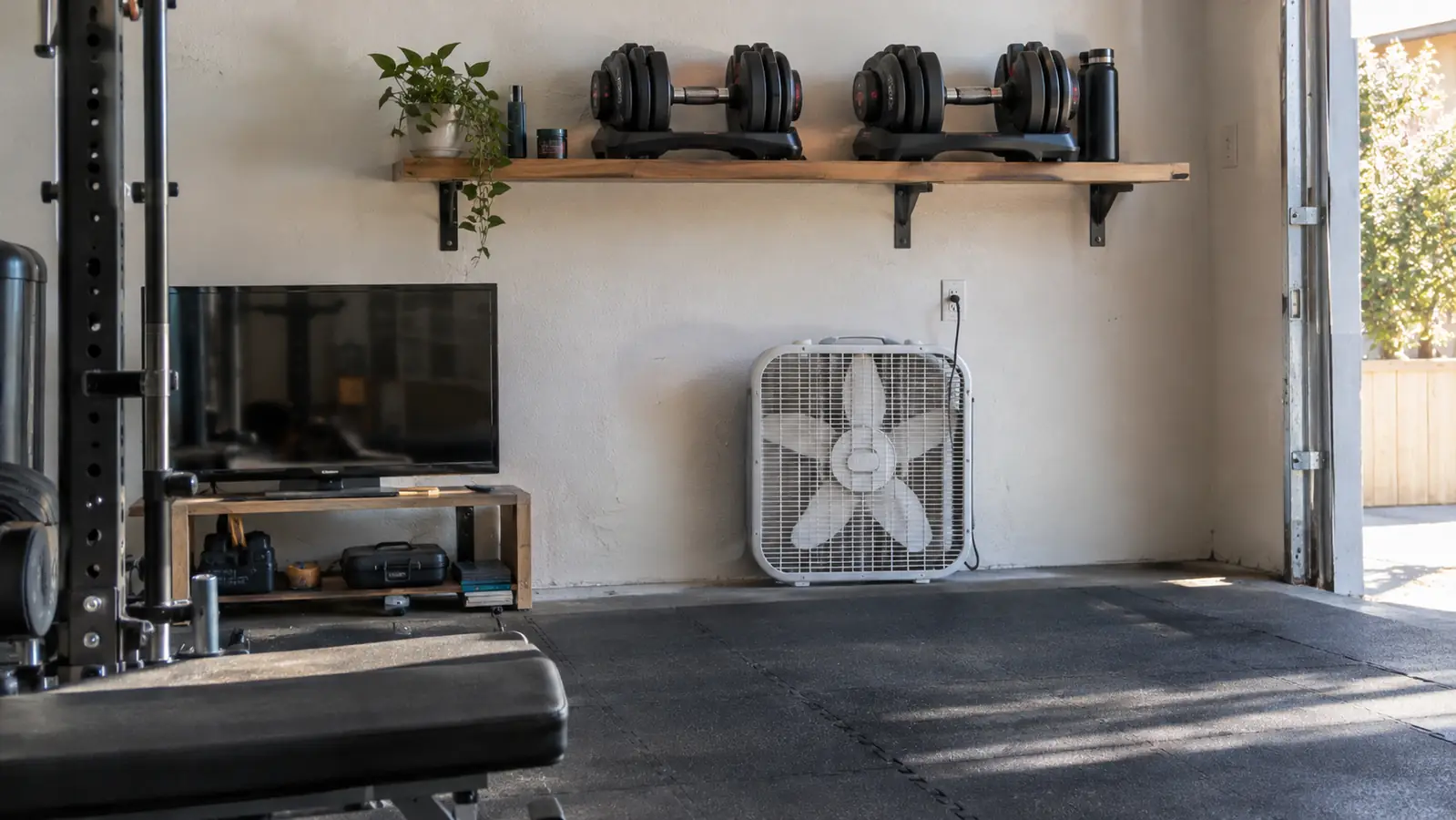
Who Should Buy Which
Buy the PowerBlock Elite EXP 90 if you train short, early, and in a small space, like I do. The speed of weight changes is the single biggest quality-of-life factor for a 30 minute workout, and the compact storage makes it the right fit for a garage that does double duty. The blocky handle is a minor cost, and you do get used to it. I stopped noticing it around day eight, and after a month I stopped thinking about it entirely. If you think you will ever want more than 50 lb per hand, the expansion path is another reason to pick PowerBlock. I have not bought the expansion kit yet, but I like that the option is there.
Buy the Bowflex SelectTech if the feel of a classic dumbbell matters more than speed, or if you need 2.5 lb increments for lighter isolation work. It is a well made set, quieter, and more intuitive for anyone who has spent years with traditional dumbbells. Just be ready to give up some floor space and some time between sets. I can also tell you who should skip both and buy a fixed set: if you only ever use two or three weights, an adjustable pair is overhead you do not need. But if you want one pair that covers the whole range and you have a garage like mine, the decision came down to whether I wanted speed or familiarity. For my garage, my schedule, and my cranky left knee, PowerBlock is the one that stayed.
Here is a simple way to decide in about sixty seconds. Think about your last ten workouts. If most of them were circuits or supersets where you changed weight five or more times, buy the PowerBlock. If most of them were straight sets where you picked one weight and stayed with it for twenty minutes, buy the Bowflex. My last ten workouts were mostly circuits, because that is what fits into 30 minutes before work. That is the whole decision, really. Speed or familiarity. I chose speed, and my knee did not complain once.
On a 30 minute morning, the PowerBlock changes weight in seconds while the Bowflex costs me minutes. In my garage, minutes are the whole game.
My pick: PowerBlock Elite EXP 90
If you want fast changes, a small footprint, and room to grow, the PowerBlock Elite EXP 90 is the adjustable dumbbell I kept. Check today's price on Amazon.
Amazon Check Today's Price on Amazon →