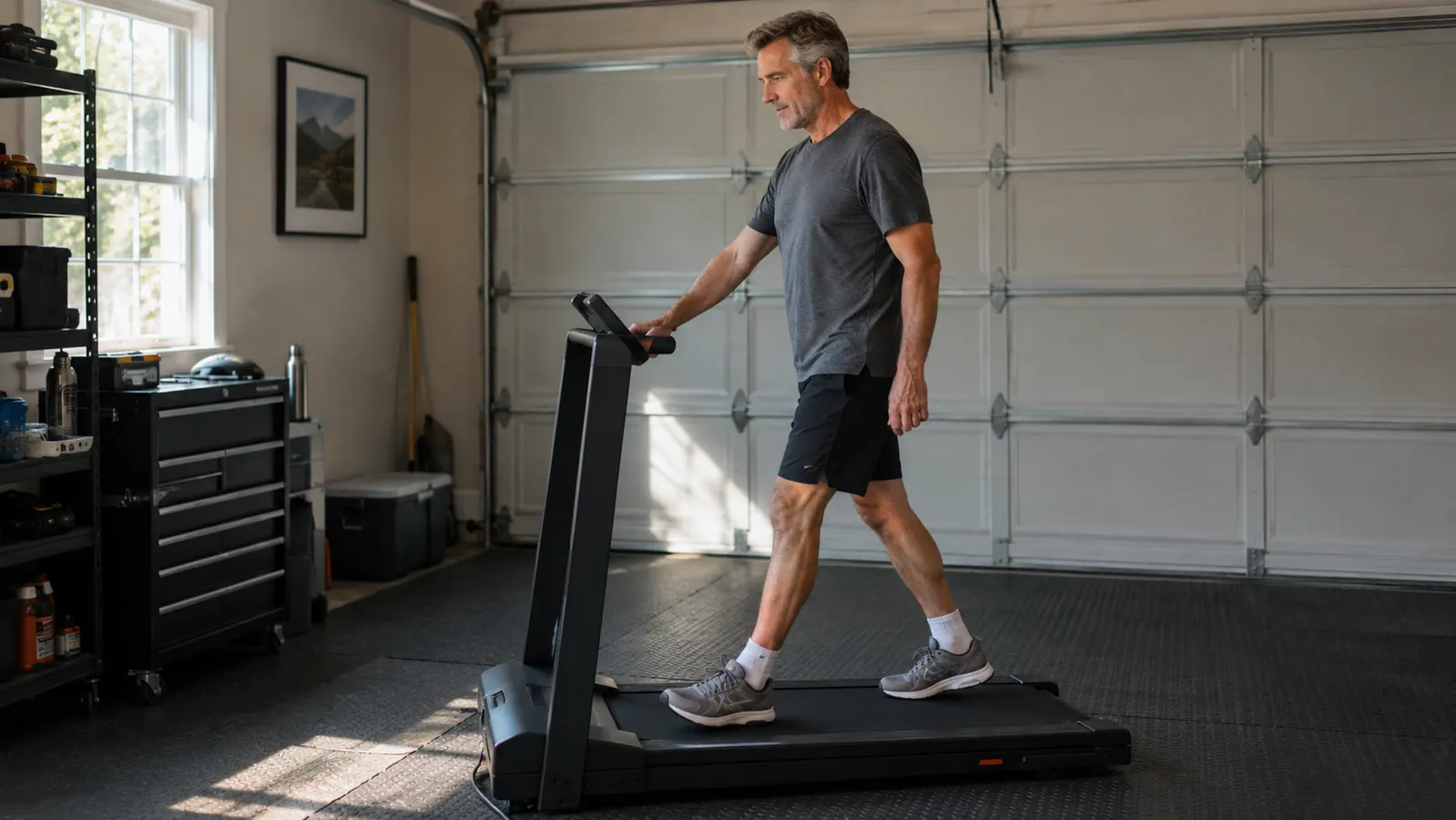
Here is the honest version of my knee story. I am Ray, I am 51, and I played pickup basketball for about 25 years on a left knee that eventually decided it was done. By the time I was 48, the knee would ache for two days after a long walk on pavement, and the idea of adding more walking felt like the opposite of smart. My doctor's advice was to keep moving but choose the surface and the pace carefully. That is how I ended up with a walking pad in my garage, and specifically how I ended up with the Viamotion Walking Pad Treadmill with Incline and Handle Bar. This is the plan I built around it for walking more without wrecking my knee.
Walk more at home without the impact of pavement
A walking pad gives you a flat, forgiving surface right in your garage. Check today's price on the Viamotion Walking Pad and see if it fits your setup.
Amazon Check Today's Price on Amazon →Step 1: Start with a short walk at zero incline and a slow speed
The biggest mistake I made with my knee was treating walking like something I did not need to warm up for. Last spring, before I owned the pad, I decided to "push through" the ache and walked three miles on pavement in brand new running shoes. The left knee swelled that night, I limped for two days, and Carmen made me promise to stop being stubborn. That failed experiment taught me the rule I use now, which is embarrassingly simple: the first three minutes on the walking pad are at 1.5 miles per hour with the incline at zero. That is slower than my natural pace, and that is the point. It gives the knee time to produce synovial fluid, which is the lubrication your joint needs before it takes real load. I read about that in a physical therapy handout and it changed how I thought about the whole problem: the knee is not a machine that needs to be pushed, it is a joint that needs to be prepared.
I set a timer for the first three minutes and I do not let myself touch the speed control until it goes off. On my first morning with the Viamotion pad, a Tuesday in early October, I timed myself: 3 minutes at 1.5, then 10 minutes at 2.5, then a slow minute at 1.0 to cool down. The whole thing fit between my coffee brewing and my shower. The Viamotion pad has a handle bar, which matters more than I expected, because I can keep a hand on it during that warmup and take some weight off the left knee. I also learned to land mid-foot instead of heel-striking, because slapping your heel down sends a shock straight up the leg into the knee. That one change took a few sessions to feel natural, but now I do it without thinking. After the three minutes, I bump the speed to 2.5 or 2.8 and walk for another ten minutes at zero incline. If the knee is quiet, I stay there. If it is not quiet, I stay at 1.5 for the whole session. That decision is the whole plan.
Step 2: Build to a daily habit before you build to a longer walk
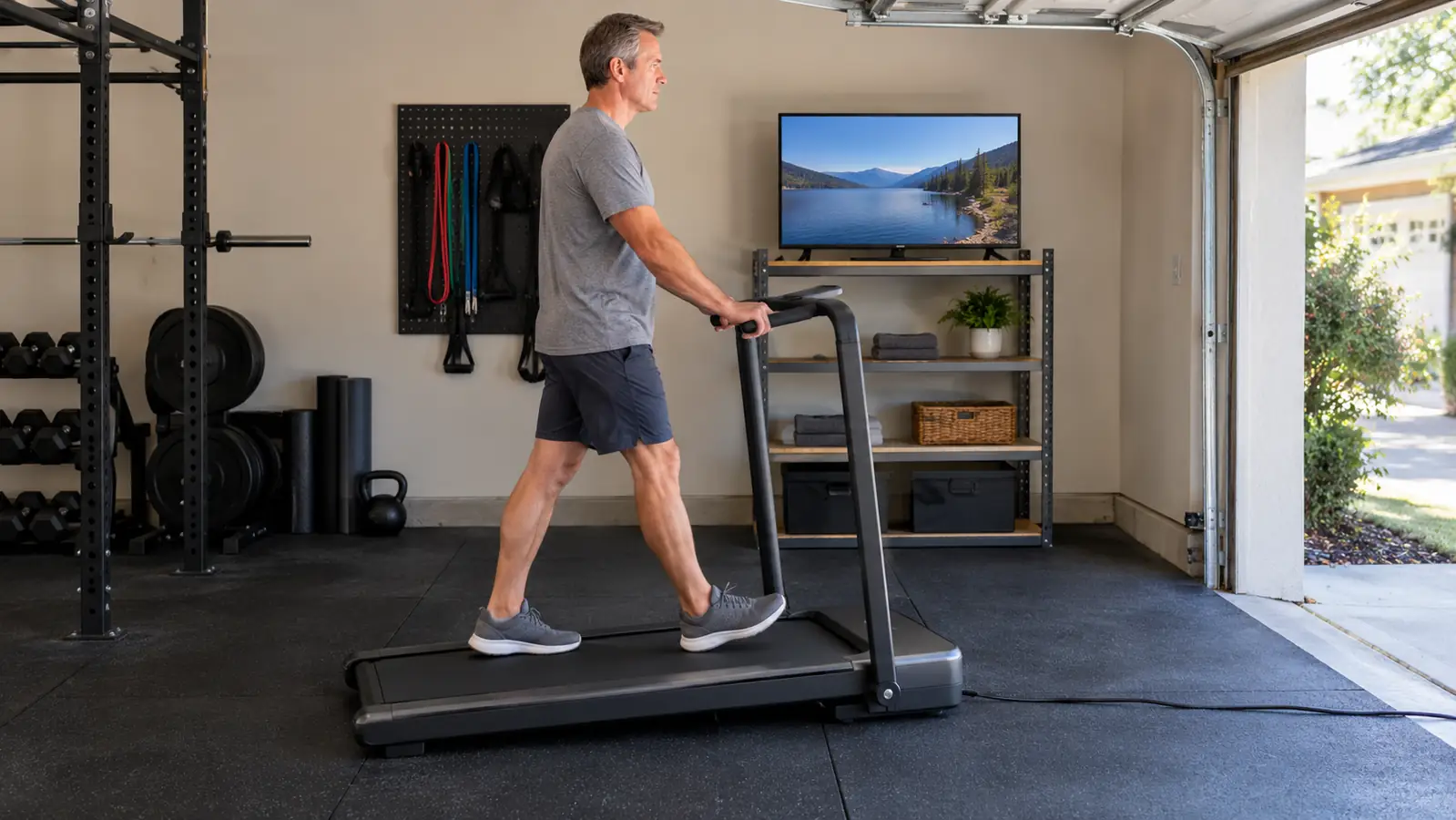
When people talk about walking more with bad knees, they usually talk about distance. I think the first goal should be frequency. Walking ten minutes every day does more for my knee than walking 40 minutes twice a week, because the joint gets regular movement without a big recovery gap. A walking pad makes this practical in a way that a neighborhood walk never did for me. I tested this on myself. The week I committed to the daily habit was the week after Thanksgiving. I walked Monday through Friday, ten minutes each night after dinner, and skipped Saturday because we had friends over. Sunday I did 15 minutes while watching football highlights. That was the week the pattern clicked: the knee stopped aching on Tuesday mornings, which had been my worst day. Before that, I had tried the once-a-week long walk approach, three miles on a Saturday, and it left me hobbling for two days. The daily ten minutes never did.
I do not have to check the weather, I do not have to change shoes if I do not want to, and I can be on the pad for ten minutes before my coffee is done brewing. The garage stays at whatever temperature it is, which in San Jose means I walk in a t-shirt most of the year. In July I ran the box fan and it was fine. In January I wore a hoodie for the first five minutes and then took it off. The pad lives against the wall next to my workbench, and pulling it out takes about thirty seconds, which is short enough that I never talk myself out of it. On days when I train in the garage, I use the pad as the warmup for my whole session. On the other days, I do a ten minute walk after dinner with Carmen while she watches something on the little TV I keep on the shelf. The Viamotion pad folds up and rolls out of the way, so the garage still works as a garage, and that matters because I still park my truck in half of it.
Step 3: Add incline only when the knee tolerates flat walking
Incline is where a walking pad gets interesting for someone with a cranky knee, because a small incline gives you more work without more impact. But it is also where I almost hurt myself by being eager. In November I got overconfident. I had walked flat for three weeks, the knee felt great, so I jumped to the third incline level and kept my usual 2.8 speed. Eight minutes in, the left knee started to complain, a dull ache behind the kneecap that I recognized from basketball. I finished the ten minutes because I am stubborn, and I paid for it: the next morning the knee was stiff and I had to take two days off. That was the last time I skipped the progression. The rule I landed on after testing my own limits is simple: do not add incline until you can walk 20 minutes at 2.8 miles per hour on a flat surface for a full week without any ache the next morning.
When you do add it, add one level at a time and keep the speed the same. I started at the lowest incline setting on the Viamotion pad and walked at 2.5 for ten minutes, then came back to flat for the rest of the session. The next week I did the same incline for 15 minutes. The incline also changes your stride slightly, which is good for the knee, but it changes the load on the Achilles too, so going slow protects both. I keep the speed at 2.5 on incline days, never higher, because the extra work should come from the grade, not from walking faster. Two months in, I can hold the lowest incline for the whole 20 minute session, and the knee is fine the next morning, which is exactly the test I use. The point of the incline is to strengthen the muscles around the knee without forcing the joint into a deep bend, and it works well for that, but only if you earn it slowly. If the knee complains, I drop back to flat and do not argue with it.
Step 4: Use the handle bar and your arms to unload the knee
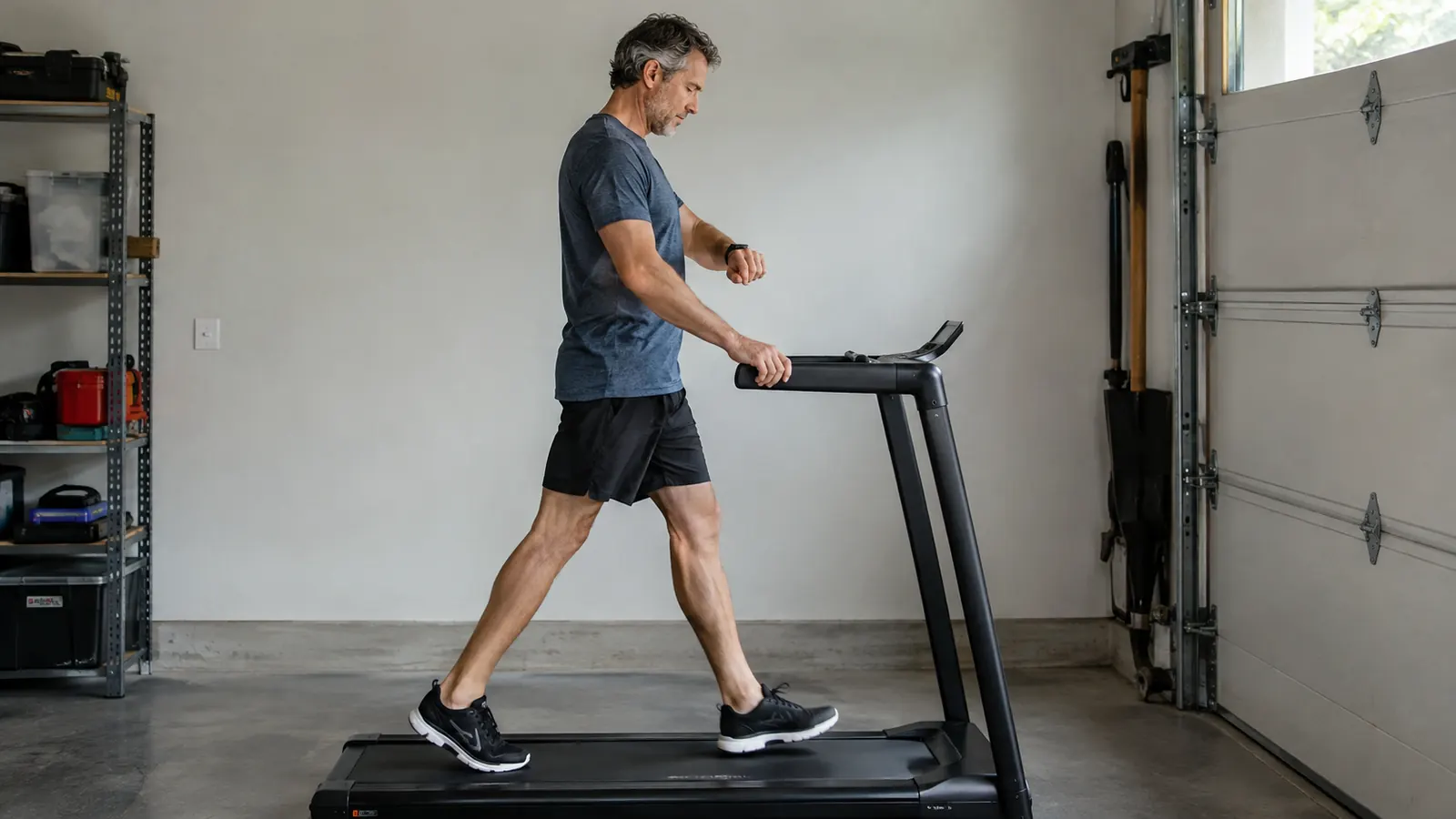
Here is something nobody told me when I was trying to walk through knee pain: your arms are part of your knee. When I keep one hand on the handle bar of the Viamotion pad and let my arm take some of my body weight, I can feel the difference in the left knee immediately. It is not a crutch. It is just smart load management, the same thing a hiker does with trekking poles. The first morning I tried the handle bar, I was skeptical. It looked like a support for people who were unsteady, and I did not want to think of myself that way. But I walked one session with my hand on it, just lightly, and the difference was immediate: the left knee took noticeably less load, and I finished the 20 minutes without the usual ache at the 15 minute mark. That is when I stopped being proud and started being practical.
I walk with a light grip and my elbow slightly bent, and I switch hands halfway through the session so I do not develop a lopsided gait. I also straighten my posture when my hand is on the bar, which sounds like a small thing but it keeps my hips level, and level hips mean the knee tracks straight instead of wobbling inward. The stiff days tend to be Mondays, after a weekend of sitting at the movies or in a restaurant booth, and on those days I use the bar for the whole walk and keep the speed at 2.0. By Wednesday, I am back to walking with no hands for short stretches, which is more progress than I expected after two months. When I first started, I kept both hands on the bar for the entire walk. The handle bar on this Viamotion model is one of the reasons I picked it over a pad with no bar at all. For someone with a bad knee, that extra support is worth the floor space.
Step 5: Track the pattern, not the daily number
The last step is the one that keeps me consistent. I do not track how many steps I get on any single day, because a bad day makes me feel like I failed. Instead I track the week: how many days did I walk, how many total minutes, and how many mornings did I wake up without knee pain. That weekly pattern tells me whether the walking pad is helping, and it gives me permission to have a light day.
My own pattern after a few months looks like this: five or six days a week, 15 to 30 minutes a session, incline on two or three of those sessions, and a left knee that aches far less than it did when I was walking on pavement. That is the outcome I was after. The Viamotion pad did not fix my knee, nothing will, but it gave me a way to keep moving that my knee can live with. That counts as a win in my book.
What Else Helps
The walking pad does the main job, but a few small things made a real difference for me. First, I keep a pair of supportive shoes by the garage door and wear them only on the pad, so the sole stays clean and I do not walk in worn-out sneakers. Second, I do a short set of calf raises and slow bodyweight squats before I step on the pad, nothing heavy, just enough to wake up the muscles around the knee. Third, I use the pad's timer as a commitment device: I decide before I start how long I am walking, and I do not cut it short unless the knee actually hurts.
I also learned to listen to the difference between a stiff knee and an injured knee. Stiffness usually works out during the slow warmup. Sharp pain does not, and sharp pain means I stop. That one distinction has kept me from turning a manageable knee into a worse knee, and it is the advice I would give anyone who asks me about walking more with bad knees: move often, move gently, and let the joint tell you what it can handle.
The Viamotion pad did not fix my knee, nothing will, but it gave me a way to keep moving that my knee can live with.
Give your knee a surface it can trust
A walking pad is not a cure, but it is a practical way to keep walking when pavement hurts. Check today's price on the Viamotion Walking Pad and see if it belongs in your garage.
Amazon Check Today's Price on Amazon →