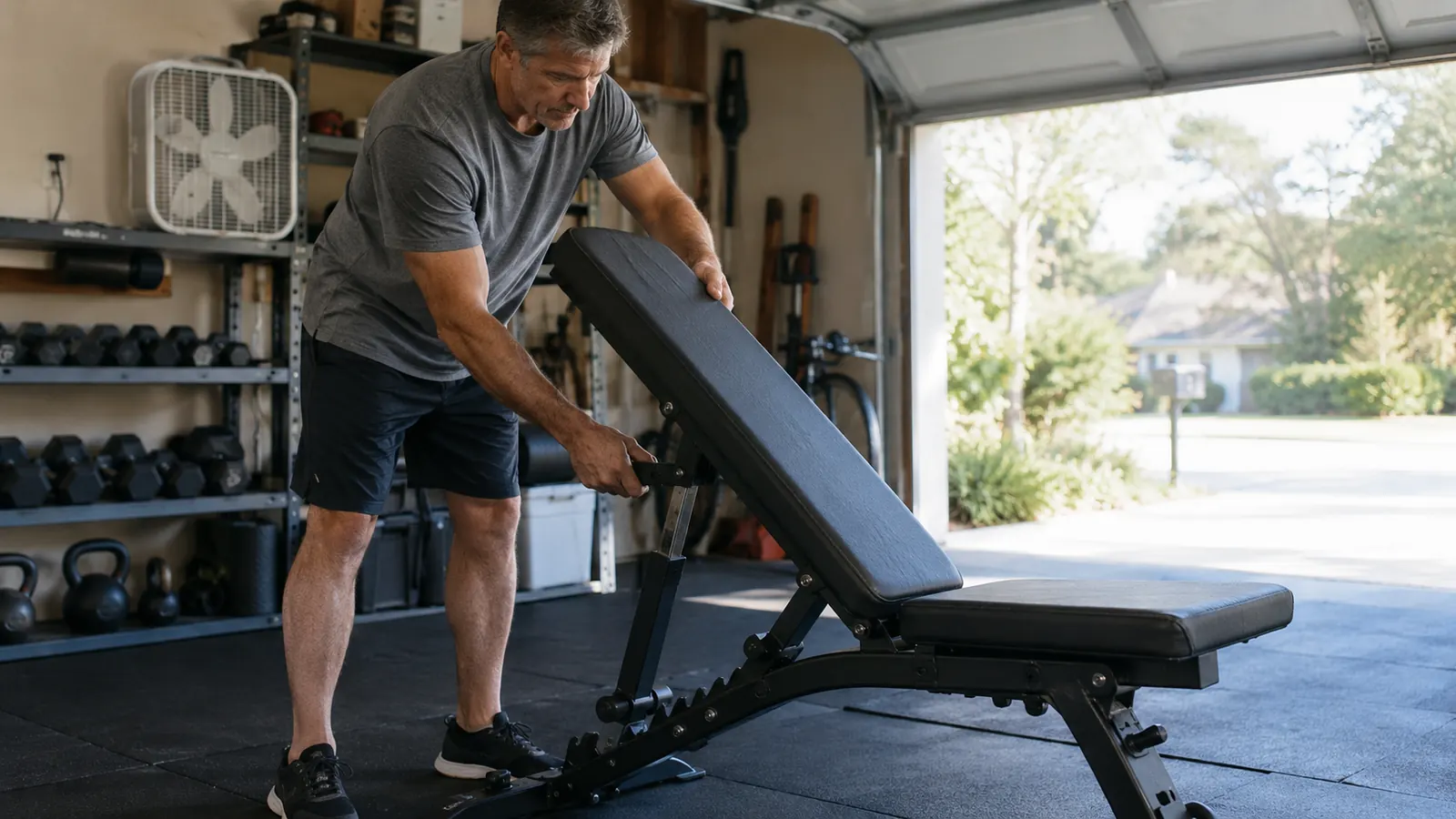
I bought the FLYBIRD WB5 adjustable weight bench in March, mostly because I was tired of doing every pressing movement on the floor of my garage. I am 51, I work in logistics, and my training time is three or four mornings a week before work, about 30 to 40 minutes when I am lucky. I do not have room for a full rack, and I do not have the patience for equipment that takes twenty minutes to set up. What I wanted was one bench that would handle incline, flat, and decline work without making me rearrange the garage every time. Six months in, I have a pretty clear picture of what this bench does well and where it cuts corners.
The honest version is this: the FLYBIRD is a very good bench for the money, and it is also a bench with real limitations that nobody puts in the product photos. The seat is firmer than you expect. The adjustment pin takes some getting used to. And the whole thing has a slight flex under heavy loads that you will notice if you are used to commercial gym equipment. None of that made me send it back. But I would have appreciated knowing it before I ordered.
The Quick Verdict
A sturdy, space-saving bench for home lifters who want solid incline and flat work without paying commercial gym prices. Just know the seat is firm, the pin is fiddly, and it is not a competition bench.
Amazon Check Today's Price →The bench I kept after six months of garage workouts
If you are weighing the FLYBIRD against cheaper benches that wobble and pricier ones that eat your floor space, this is the one I would order again. Check today's price on Amazon and see if it fits your garage.
Amazon Check Today's Price on Amazon →How I've Used It
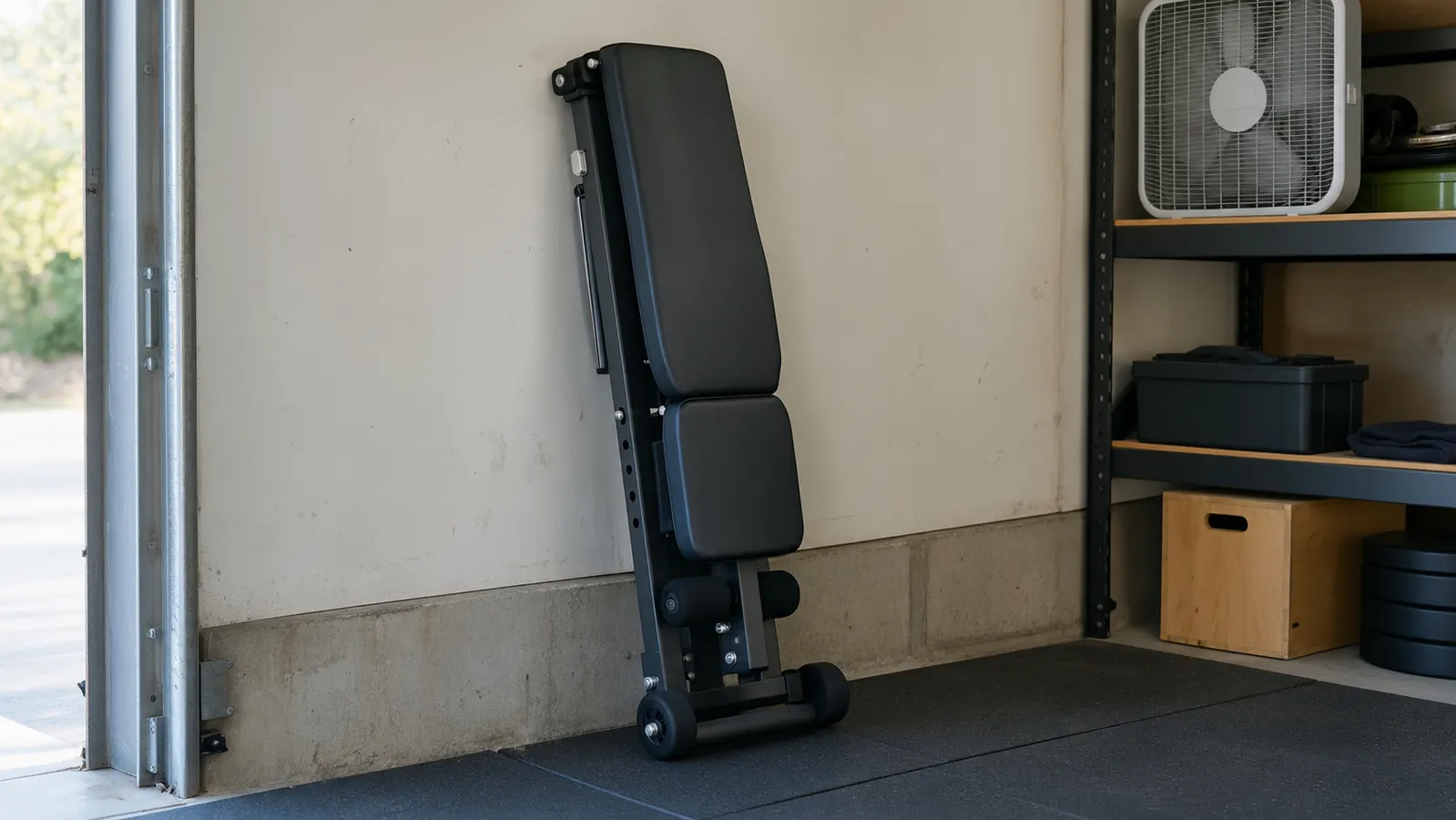
My setup is one half of a two-car garage in San Jose. Rubber stall mats on the floor, a box fan on a shelf, a small TV on a shelf, and a bar and plates in the corner. The FLYBIRD lives against the wall when I am not using it, folded up, and I pull it out for a session. That is the main reason I picked it over a fixed commercial bench: it folds, and it has wheels on the front leg so I can move it without dragging it across the mats.
In a typical week I use it for flat dumbbell presses, incline presses, seated shoulder work, and the occasional decline sit-up. My wife Carmen uses it a couple of mornings a week for hip thrusts and dumbbell rows. So it gets moved, adjusted, and folded pretty much every day. That daily cycle is where a lot of benches fail, and it is where the FLYBIRD has actually held up better than I expected.
The routine is the same most mornings. I back the car out around 6:10, set the fan on low, and pull the bench from the wall. The open floor is about 8 by 10 feet of stall mats, and the bench takes up maybe a third of that when it is set to flat. I keep a pair of 40s and a pair of 60s on a stand by the wall, and the bench is open and pinned before I finish my first warm-up set. None of that sounds like much, but it is the whole game: if this bench took five minutes to set up, I would skip it on a Tuesday when the alarm went off late.
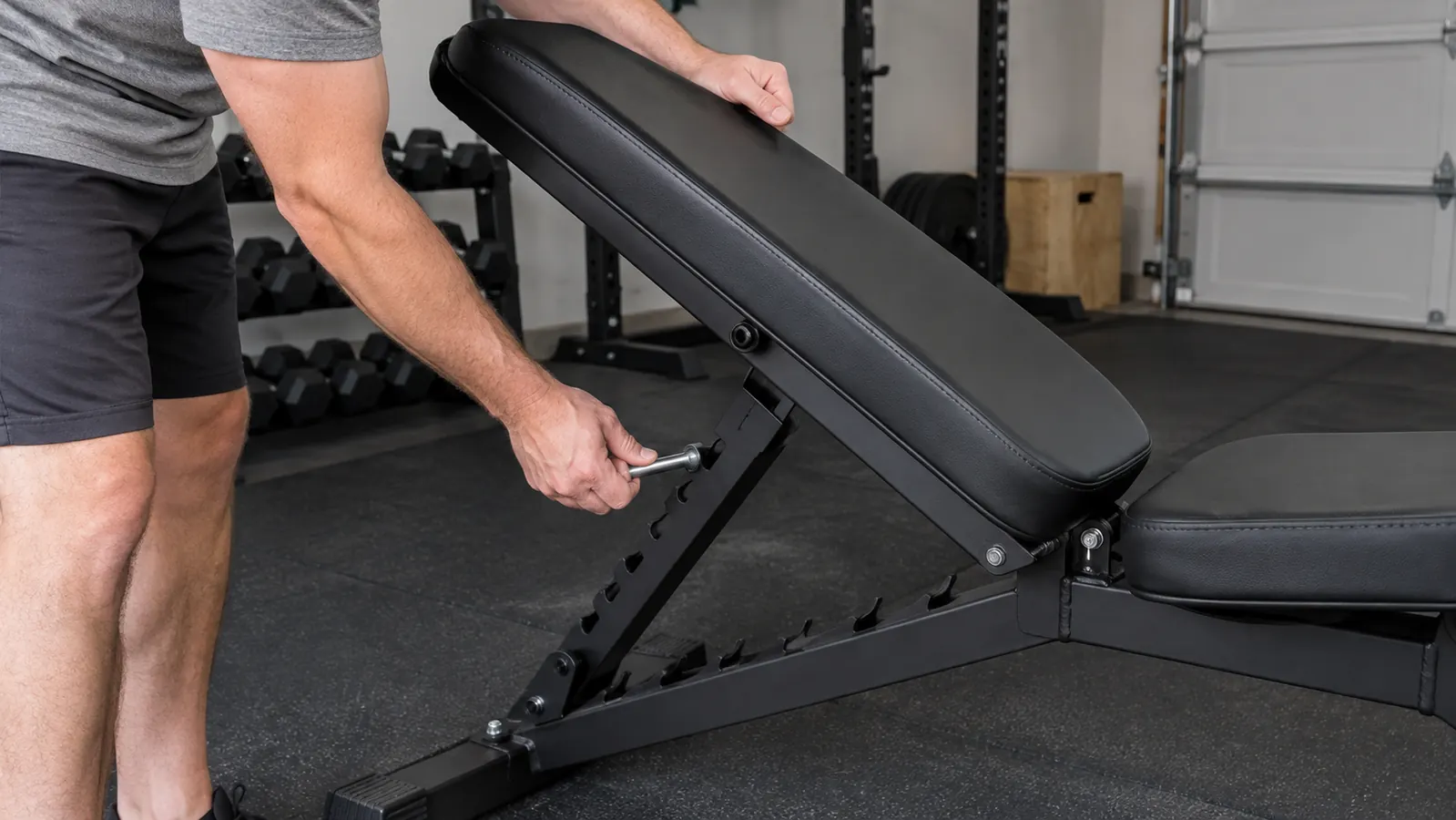
The adjustment system is a pin that you pull and slide into one of the holes in the backrest bracket. It sounds simple because it is simple. There is no lever to break, no gas strut to leak, no ratchet mechanism to strip. The pin is just a chunk of steel on a spring, and after six months of daily adjustments it still clicks into place cleanly. The tradeoff is that it is not a one-hand adjustment. You have to lift the backrest slightly to take the pressure off the pin, pull the pin, move the backrest, and let the pin seat. It takes about three seconds once you get the rhythm, and it is the kind of thing that would annoy you in a commercial gym but is completely fine at home.
What Nobody Tells You About the FLYBIRD
The first thing nobody tells you is that the seat is firm. Not uncomfortable, but firm. The padding is dense foam wrapped in a textured material that does not feel like a luxury car seat. For a 30 to 40 minute session it is fine. For longer sessions, or if you are bony in the hips, you will feel it. My wife noticed it more than I did on hip thrusts. It is not a reason to skip the bench, but it is a reason to know what you are getting.
The second thing is the flex. Under a heavy dumbbell press, say 80s or 90s in each hand, the frame has a slight give. It is not a wobble and it is not dangerous. It is the kind of flex you feel through your shoulders and notice when you set the dumbbells down. I noticed it for the first time on a Saturday in June. I had worked up to 85s on the flat press, about as heavy as I go without a spotter, and on the last rep of the third set the frame settled under me when I brought the weights to my chest. It was not a shift, just a small give, and it did not happen on every rep. I stopped, checked the pin, checked the leg locks, and everything was seated. The flex is in the design, not in a loose joint. A commercial bench with a thicker frame and a wider footprint does not do this. The FLYBIRD is an 800 lb rated bench, and I believe that rating for the frame, but the bench is also designed to fold, and folding means a narrower stance and a little less rigidity than a welded monster that never moves.
The third thing is the adjustment pin placement. The pin is on the side of the backrest bracket, which means you have to reach around the side to adjust it. If the bench is against a wall, you need a few inches of clearance on the pin side. I learned this the hard way when I first set it up flush against the wall and had to pull the whole bench out to change the angle. Give it six inches of breathing room and it is a non-issue.
The pin is just a chunk of steel on a spring, and after six months of daily adjustments it still clicks into place cleanly.
Build Quality and Materials
The frame is heavy-gauge steel with a powder coat that has held up well. I have scraped it against the wall, dragged it across the stall mats, and left it folded in a garage that gets warm in the summer. No rust, no chipped paint, no squeaks. The welds are clean, and the joints that matter, the pivot points for the backrest, have not developed any play.
Assembly took about forty minutes with two wrenches and the Allen key that came in the box. The parts were labeled, the instructions were mostly pictures, and the only mildly annoying step was lining up the backrest bracket while holding the pin spring in place. The hardware is all standard hex bolts, so if I ever lose one I can replace it at the hardware store instead of ordering a special part. When the bench is open, the legs span about 42 inches at the widest point, and folded it leans against the wall at roughly 17 by 34 inches. I measured it because I wanted to be sure the car still fit in the garage.
The upholstery is where the FLYBIRD is clearly a value bench rather than a premium one. The material is a synthetic leather that looks good and wipes down easily, but it is not the thick, plush stuff you find on a much more expensive bench. After six months there is some mild surface wear where the dumbbells rest during racking, but no tears and no peeling. The stitching has held. I would call it durable but not luxurious.
The wheels on the front leg are a small detail that makes a big difference. When the bench is folded, you tilt it onto the wheels and roll it wherever you need it. It is not a wheeled cart, but it means I can move the bench from the wall to the center of the garage in about ten seconds without lifting. For someone with a cranky knee, that matters more than it sounds like it should.
Performance Over Time
I have put in roughly 80 sessions on this bench since March. That is not a huge number, but it is enough to see how a piece of equipment wears. The adjustment pin still seats firmly. The backrest still locks at every angle with no slop. The seat pad has not compressed in a way I can feel. The frame has not developed any new creaks. The only real sign of age is the surface wear on the upholstery where the dumbbells touch.
One thing I did not expect: the bench has been through a full San Jose summer in an uninsulated garage. We had a stretch in August where it hit the mid-90s for a week and a half, and the garage got hot enough that the dumbbell handles were warm to the touch. The bench sat folded against the wall the whole time. When I pulled it out after that stretch, the pin moved freely and the upholstery had not softened or blistered. The only maintenance I have done is wiping the pad down with a damp cloth once a month and checking the hex bolts after the first couple of weeks. None of them needed tightening.
The first time I used it with a barbell, I learned more about my garage than about the bench. The bench itself was solid in the flat position. The problem was the stall mats, which are thick enough that the bar rolled slightly on the floor between reps. That is not the bench's fault, and it did not shake the bench loose. But it is the kind of thing that makes a home gym review messy: your results depend on the floor, the bar, and the plates as much as the bench. On the stall mats, with the bench pinned flat, I have pressed 135 lb for sets of eight without the bench moving at all.
The decline position is the one I use least, and honestly it is the one that feels most like a compromise. The bench does decline, but the range is modest and the foot catch is not as secure as a dedicated decline bench. For the occasional decline sit-up it is fine. If decline pressing is a core part of your program, this is not the bench for you.
The flat position is where the FLYBIRD shines. It is a solid, stable platform for dumbbell presses, and the width of the pad is generous enough for a broad-shouldered guy. The incline positions cover the range I actually use, from a slight incline for shoulder work to a steep incline for upper chest. I have not once wished for a position that was not there.
Who This Is For
The FLYBIRD is for the person who wants a real bench in a real home gym without dedicating a permanent corner to it. It is for the person who trains alone, early in the morning, and needs equipment that is ready to go in under a minute. It is for the person who is honest about the fact that a budget bench is not a premium bench, and is fine with that trade because the premium bench would not fold up against the wall.
It is also for the person with a cranky knee. The bench lets me do incline work without loading my knee the way a deep squat does, and the wheels mean I am not lifting and carrying a heavy piece of steel every morning. Those two things alone have kept me consistent, and consistency is the whole game at 51.
Who Should Skip It
If you are a heavy powerlifter who benches 300+ and wants to train with a barbell on a bench that does not move a millimeter, buy a commercial bench. The FLYBIRD is rated for 800 lb, but it is not built like a competition bench, and the flex under heavy loads will bother you even if it is not a safety issue.
If you want a bench that adjusts with one hand while you are lying on it, this is not that bench. The pin system works, but it requires you to get up, pull the pin, and set the angle. It takes three seconds, but it is not the instant hydraulic adjustment you get on a much more expensive bench.
And if you are looking for a bench to do heavy decline barbell work, skip it. The decline range is modest and the foot catch is not built for serious loading. This is a bench for flat and incline work, full stop.
What I Liked
- Folds flat and rolls on wheels, so it disappears against a garage wall
- Solid steel frame with clean welds and no squeaks after six months
- Simple pin adjustment that has not worn out or stripped
- Stable enough for heavy dumbbell work in the flat and incline positions
- Easy to move around, which matters when you share the garage with a car
Where It Falls Short
- Firm seat padding that you feel on longer sessions
- Slight frame flex under very heavy loads
- Adjustment pin requires two hands and a few seconds
- Decline position is a compromise, not a real decline bench
- Upholstery shows surface wear where dumbbells rest
Alternatives I Considered
Before I settled on the FLYBIRD, I looked at a few other benches. The first was a cheap flat bench with no adjustment, which was cheaper but would have meant buying a second bench later for incline work. The second was a commercial-style adjustable bench that did not fold, which was more solid but would have taken up a permanent footprint in a garage that already holds a car, a workbench, and a shelf of bins. The third was a much more expensive folding bench with a hydraulic adjustment, which was nicer but cost more than twice as much for a feature I would use maybe twice a week.
The FLYBIRD sat in the middle of all of those, and the middle is exactly where I needed it to be. It is not the cheapest, not the most solid, not the most convenient. It is the one that does all three well enough that I do not think about the bench when I am training. That is the real test of home gym gear: not whether it impresses you, but whether it gets out of your way.
Still deciding? This is the bench I would order again
Six months in, the FLYBIRD is the piece of gear I would buy first if I were starting my garage gym over. Check today's price on Amazon and see if it fits your space.
Amazon Check Today's Price on Amazon →