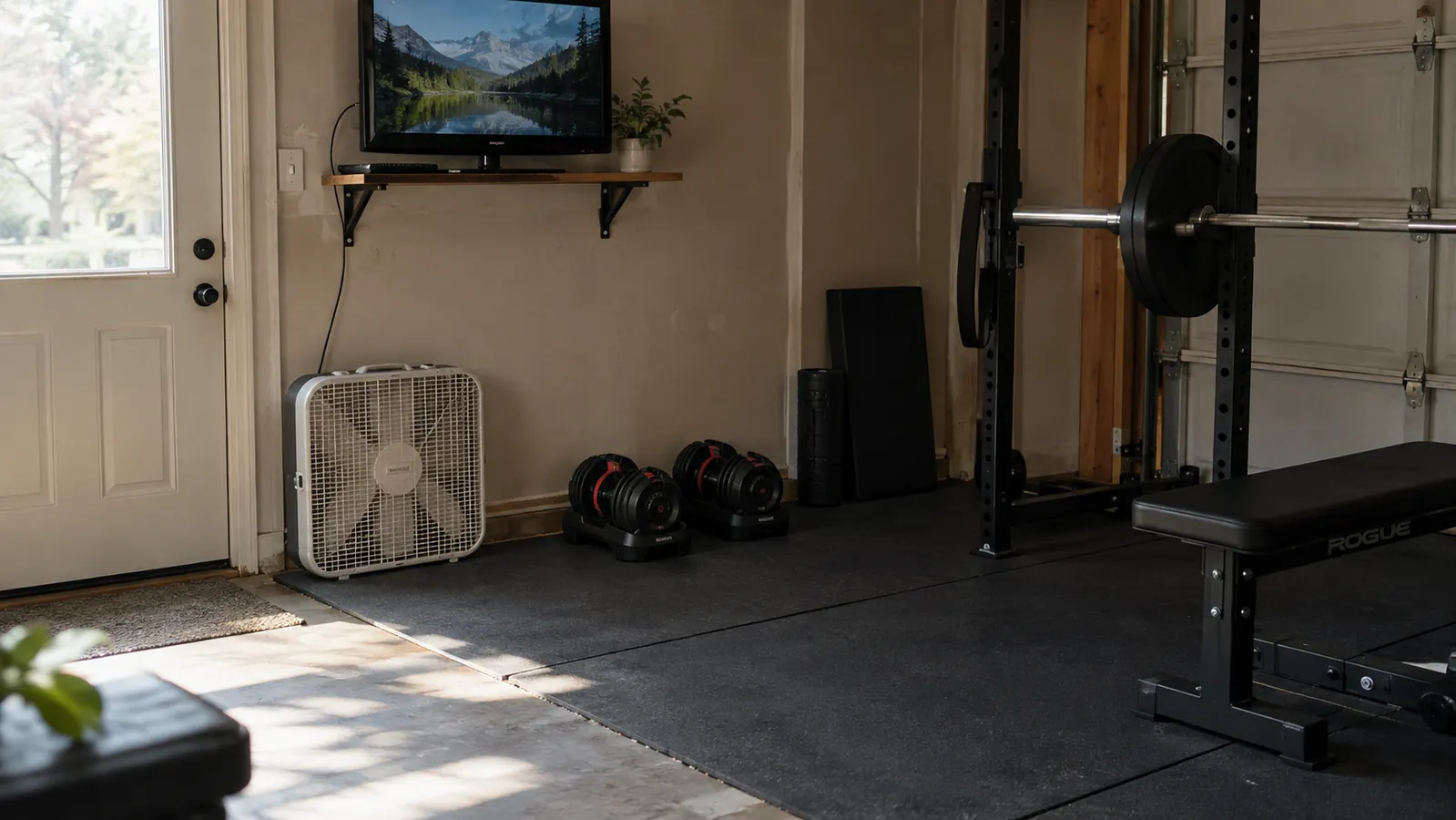
Here's the thing about strength training at home: the equipment is usually the problem, not your schedule. A full dumbbell rack eats a wall. A multi-station gym eats a whole room. A barbell setup eats the garage and then some. I don't have a spare room. I have half of a two-car garage in San Jose, with the water heater on one side and a shelf holding a small TV on the other, and my entire free-weight setup for the last year and a half has been one pair of PowerBlock Elite EXP adjustable dumbbells. It's the first home training setup I've actually kept using, and I'd like to walk you through exactly how I made it work.
The false choice most people run into is either pay for a gym membership or fill a room with iron. I've tried both. The gym membership lapsed twice, and the wall of dumbbells never happened because there wasn't a wall to give it. What I needed was something that covered the same range as ten pairs of dumbbells, changed weight in seconds, and fit in a corner. That's the whole argument for adjustable dumbbells, and the PowerBlock Elite EXP is the version I've lived with long enough to trust. The steps below are the ones I wish someone had handed me on day one.
A 5 to 50 pound dumbbell set that fits on a doormat
The PowerBlock Elite EXP replaces a rack of individual dumbbells with one compact base per hand, and it adjusts in seconds. I've used this set three or four mornings a week for a year and a half, and the weight change still works as smoothly as the day it arrived. Check today's price on Amazon and see if it fits your corner the way it fits mine.
Amazon Check Today's Price on Amazon →Step 1: Give the space a fair look before you buy anything
Measure first. You don't need a room, but you do need a rectangle. My training space is roughly eight by ten feet, one half of the garage, with rubber stall mats laid over the concrete. The dumbbells sit in a corner on low bases that take up less floor space than a doormat. Everything else, the bench, the box fan, the shelf with the TV, fits around them. If you have a corner that size, you have enough room for a real strength setup, and that's true whether the corner is in a garage, a spare bedroom, or the end of a hallway.
I learned this the hard way. My first attempt at a home setup was a folding bench and a few pairs of fixed dumbbells, and the dumbbells ended up in a pile under the workbench because there was no good place for them. Adjustable dumbbells solve that specific problem. One base, one footprint, and every weight from 5 to 50 pounds lives in that same spot. When I want to press, I press. When I want to row, I row. The weights don't have to live somewhere else in between, because the whole range is already sitting where I stand.
Ventilation matters more than you expect. I keep a box fan in the corner and crack the garage door on warm mornings. The room doesn't need to be pretty, it needs to be usable at 6:15 in the morning, which means enough light to see the selector pin and enough air that you don't dread being in there. A small room that feels good to walk into gets used. A small room that feels like a closet doesn't.
Step 2: Set up the bases and learn the weight change cold
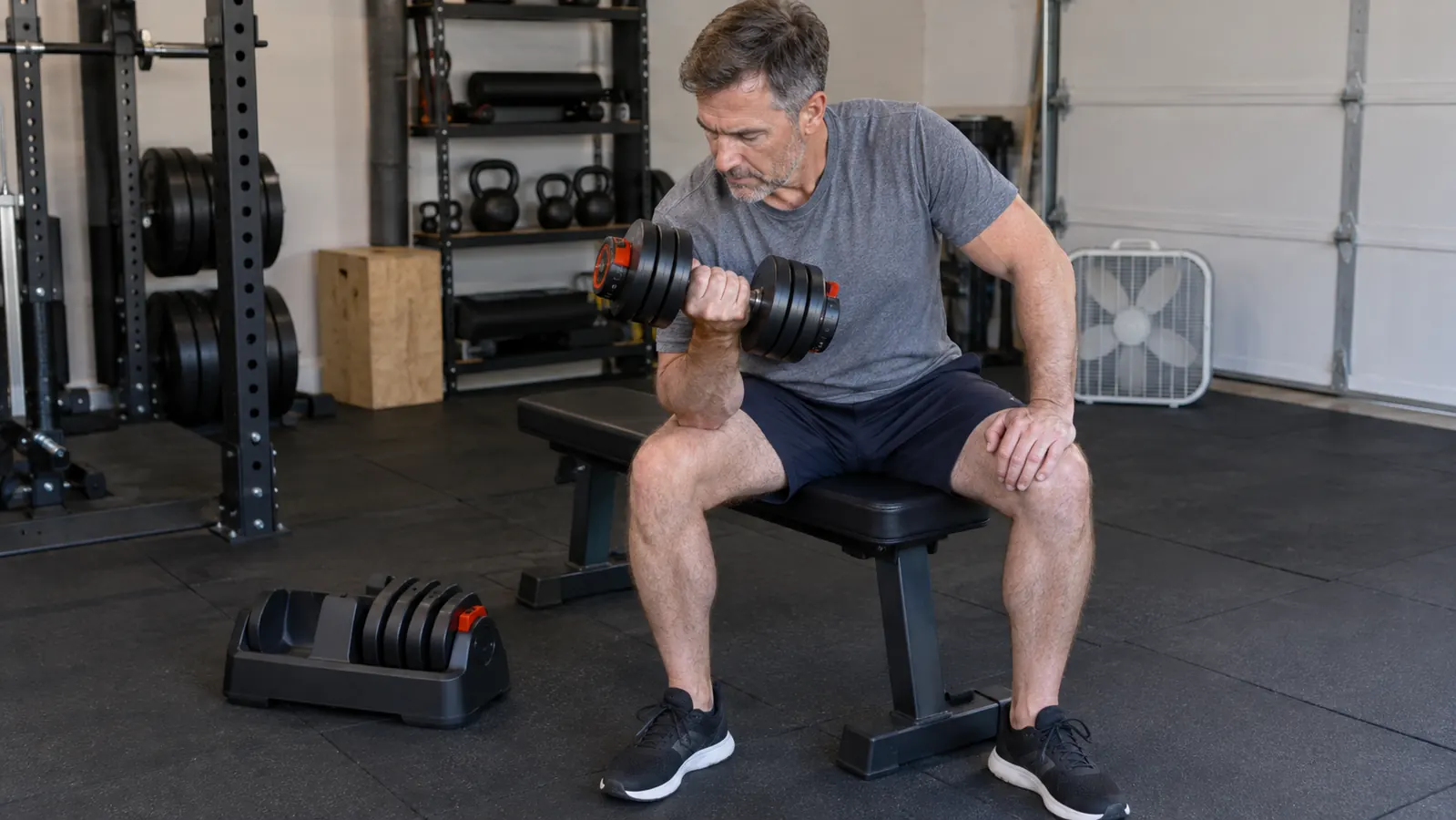
The PowerBlock system works with a selector pin. You set the dumbbell in its base, slide the pin to the weight you want, and lift. The plates you aren't using stay in the cradle, so you never touch a collar, never spin a dial, and never wrestle a plate off the end of a bar. The first time you do it, it takes ten seconds and feels strange. By the end of the first week it's automatic, and that speed is the whole reason the set actually gets used.
I keep the bases on the floor, side by side, never stacked. The instructions call for a flat, level surface, and rubber stall mats are flat enough. When Carmen uses them, she sets the pin lower and works in a lighter range. It takes her about as long to change weights as it takes me, which is to say, a few seconds and no swearing. The bases stay where they are, and the only thing that moves is the handle you lift.
One honest note: the change is fast, but it is not instant the way a spin of a dial is instant. If you are supersetting and switching weights every set, you will feel those extra seconds. I don't superset. I do straight sets, change the pin, move on, and the pause between sets is long enough anyway. For the way I train, the trade is worth it, and I'd rather spend five seconds changing weight than spend a weekend building a rack.
Step 3: Build a thirty minute routine you can do before work
My default workout is four movements, three or four mornings a week, thirty to forty minutes including the warm-up. Goblet squats, overhead press, a row, and a floor or bench press. That covers legs, shoulders, back, and chest with one piece of gear, and it takes less time than the drive to the gym used to take. I keep the reps in a range I can handle, eight to twelve for most movements, and I add weight when the top of the range gets easy.
I'm careful with the knee. Years of pickup basketball left me with a left knee that objects to deep loaded squats, so I keep goblet squats at a comfortable depth and I warm up with bodyweight first. The dumbbells make this easy: start light, work up, and stop at the depth that feels sound. No one is watching, so there's no reason to chase a depth that hurts. If your body has its own cranky joint, you already know the rule: work around it, don't push through it.
The point of a small room setup is that you can go from bed to working set in about fifteen minutes. I pour coffee, turn on the box fan, do a quick warm-up, and I'm into the first set before I'm fully awake. By the time the work is done, the day hasn't started yet. That's the real advantage of training at home. You're not negotiating with a gym schedule, a commute, or a parking lot. You're just walking to the corner of the garage.
Step 4: Use the small increments and write the numbers down
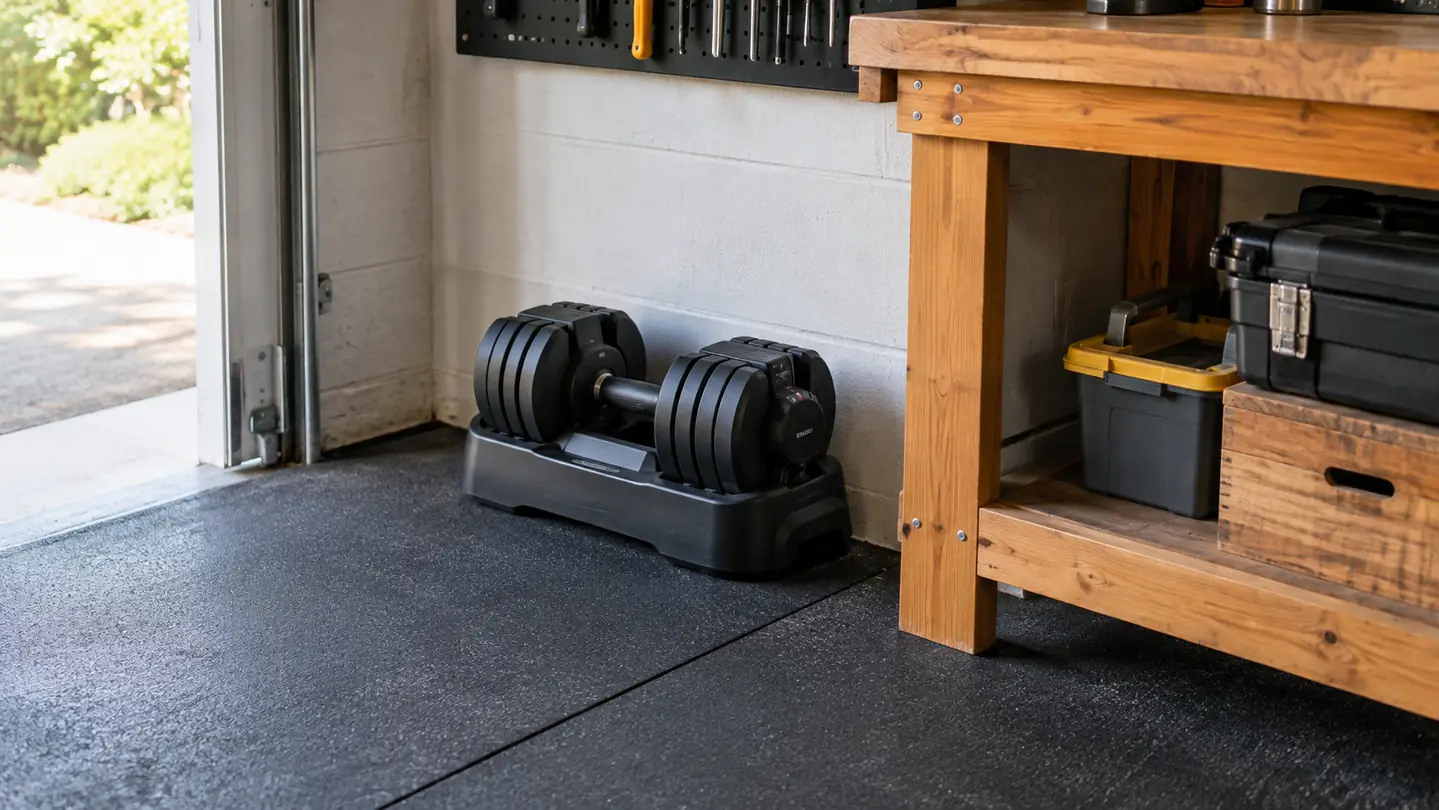
The Elite EXP goes from 5 to 50 pounds per dumbbell, and the early part of the range moves in 2.5 pound steps. That matters more than it sounds. When you're stuck at a weight, a full five pound jump can be too big, and the lift stalls. Two and a half pounds is exactly the nudge you need to keep progress moving without resetting your form. I've used the small steps to get past plateaus on the overhead press twice in the last year, and both times the tiny jump was the difference.
I keep a spiral notebook on the shelf next to the TV. Every workout gets the date, the movements, and the weight. It sounds like homework, but it's the difference between guessing and knowing. When the notebook shows 40 pounds for eight reps three weeks in a row, I know it's time to try 42.5 or 45. When I look back and see that I pressed 35 pounds a month ago, I know the program is working even on mornings when it doesn't feel like it.
The notebook also catches the bad weeks. If I've been skipping sessions, I see it in the numbers, and I drop the weight down for a week instead of pretending nothing happened. That honesty is the whole ballgame with home training. Nobody else is keeping score, so the log has to. It takes ninety seconds a workout, and it's the cheapest coach I've ever had. If you track nothing else, track the weight and the reps, because those two numbers will tell you more than any app.
Step 5: Recover like it's part of the job
Training in a small room is easy. Recovering is the part that takes discipline. I train three or four mornings a week, never the same muscles two days in a row, and Friday night is for a movie and dinner out with Carmen. The rest days aren't optional. They're when the strength actually happens. If you train hard five days a week in a small room, you'll burn out, and the dumbbells will sit in the corner for a month. I've seen it happen. I've done it.
Sleep is the other half. I'm 51, I work in logistics, and I'm not trying to look like anything in particular. I'm trying to stay strong enough to move things around the house, handle the job, and keep my knee from going backward. That version of strength is built with progressive weight and recovered with sleep, and there's no way around it. The garage gym doesn't care how many hours you slept. Your joints do.
If something hurts, I back off. That's the rule that's kept me training for a year and a half without an injury that stopped me. The knee gets extra warm-up, the shoulders get lighter pressing days when they need it, and the dumbbells get used again the next morning. Consistency beats intensity in a small room. A modest workout you actually do three times a week beats a heroic one you do once.
What Else Helps
The dumbbells are the core of the room, but three small things make them work better. A plain adjustable bench gives you press and row variations without taking up much space. Rubber stall mats protect the floor and keep the bases from sliding. A doorway pull-up bar adds a pulling movement that dumbbells don't cover well. None of it needs to be fancy, and none of it needs to cost much. The bench folds, the mats stay on the floor, and the pull-up bar comes down when company visits.
What you don't need matters just as much. No rack, no barbell, no leg press, no machines. In a small room, every piece of gear has to earn its footprint, and the PowerBlock set earns its corner harder than anything else I've tried. If you're starting from an empty corner, this is the piece I'd buy first. Everything else can wait until the dumbbells prove you'll actually show up.
Ten pairs of dumbbells used to need a wall. This set needs a corner smaller than a doormat, and I've added weight to every lift I track.
That's the whole setup, and it's been working for me for a year and a half. Not because I'm disciplined, because I'm not especially. It works because the room is small, the setup is ready, and the weights change in seconds. When the barrier between you and a workout is this low, you do the workout. That's the entire trick.
If you're going to buy one piece of home strength gear, make it this one
I've trained with the PowerBlock Elite EXP for a year and a half, three or four mornings a week, in a corner of my garage. It replaced a wall of dumbbells, it changes weight in seconds, and it still gets used. Check today's price on Amazon and see if it fits your corner.
Amazon Check Today's Price on Amazon →