I bought the PowerBlock Elite EXP set last fall with a very specific goal: stop driving twenty minutes to a gym I barely used. I am 51, I work in logistics, and my left knee has been cranky since a pickup basketball habit caught up with me. I wanted something I could use at 6:15 in the morning in my garage, without waiting for a squat rack or wiping down someone else's bench. The PowerBlock name kept coming up in every search, so I ordered the 5 to 50 pound set and waited.
Six months later, I have strong opinions. Some of them are the ones you read in every review. Some of them are the things nobody tells you, like the fact that the first time you use these, you will feel like you need an instruction manual just to change the weight. That feeling passes. But it is worth knowing about before you buy.
The Quick Verdict
The PowerBlock Elite EXP is the best home dumbbell I have used, and I have used a lot of them. It is not perfect. The weight change is slower than a rack of fixed dumbbells, the expansion kit is expensive, and the cradle takes up more room than the photos suggest. For a 30 to 40 minute garage workout three mornings a week, it is the piece of gear that actually gets used.
Amazon Check Today's Price →Skip the gym drive. See today's price on the PowerBlock Elite EXP.
If you are tired of fixed dumbbells taking over your garage and you want one set that goes from 5 to 50 pounds, this is the one I kept. Check the current price on Amazon before you decide.
Amazon Check Today's Price on Amazon →How I've Used It
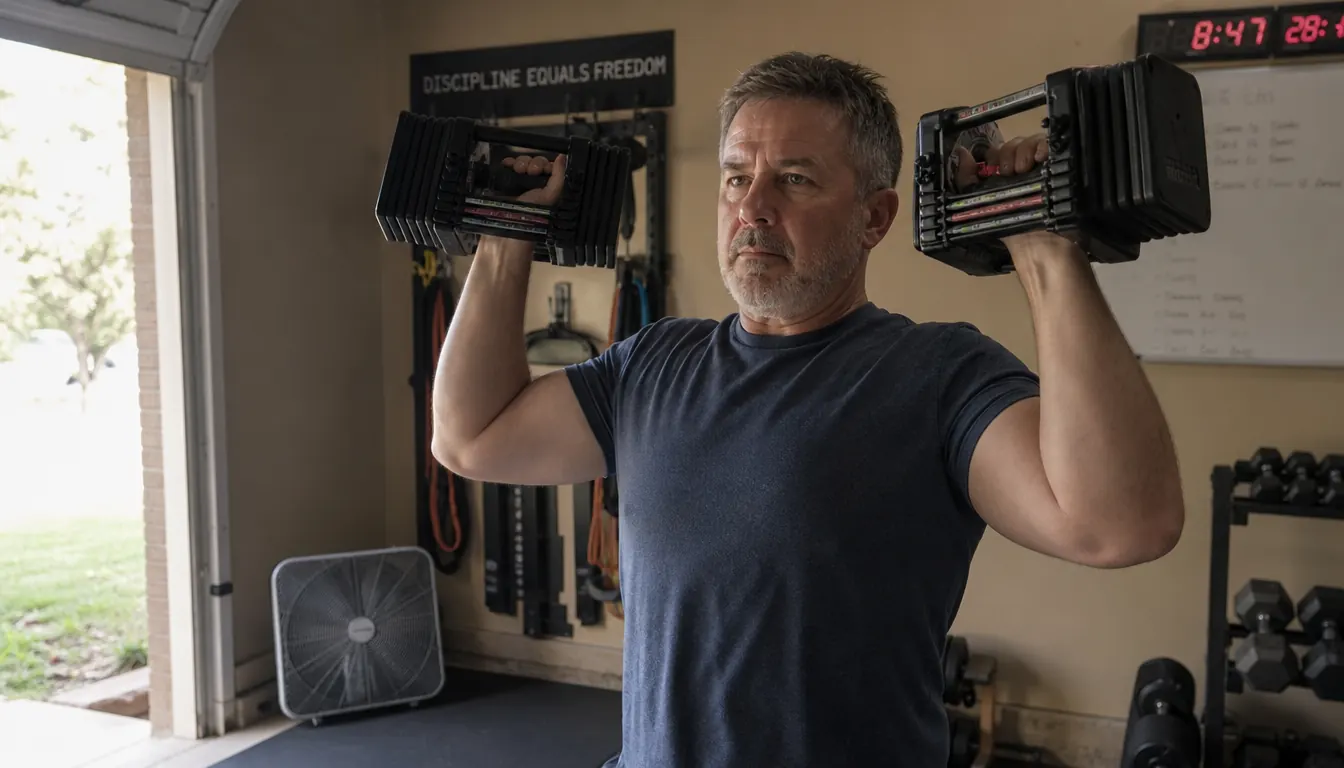
My setup is one half of a two-car garage. Rubber stall mats on the floor, a box fan in the corner, a small TV on a shelf. I train three or four mornings a week before work, about 30 to 40 minutes, more on Saturday. Carmen, my wife, uses the dumbbells a couple of evenings a week for lighter work. That means the PowerBlock set gets handled by two people with different strength levels, which is exactly the scenario these are designed for.
The first session was a Tuesday in early October. I set both dumbbells to 20 pounds, did three sets of ten overhead presses, and spent the rest of the morning wondering if I had made a mistake. The pair felt top-heavy in my hands, the plates hummed against each other on the way up, and the selector pin clicked in a way that did not inspire confidence. By the third session I stopped noticing any of it. The top-heavy feeling was just how stacked plates sit on a short handle, and the hum was the plates settling into place. Neither one ever turned into a real problem.
The Elite EXP covers 5 to 50 pounds per dumbbell in 2.5 pound increments up to 25, then 5 pound jumps after that. For me, that range is plenty. I am not trying to set records. I am trying to keep my shoulders and back happy, do some pressing and rowing, and not make my knee worse. The 50 pound ceiling is a real ceiling, though. If you are already benching 80 pound dumbbells, this set will feel light fast. The 2.5 pound jumps up to 25 are the detail I did not know I needed. With fixed dumbbells, the jump from 20 to 25 always felt like a leap. Here, I can creep up one step at a time, which matters when you are working around an old injury.
On a Saturday in mid-January I ran a full circuit without stopping to reset the pins more than twice: goblet squats at 35 pounds, walking lunges at 25, overhead press at 30, bent rows at 40. The knee complained during the lunges and I cut those short, but the dumbbells never gave me a reason to stop. Carmen uses them a couple of evenings a week for lighter shoulder and arm work at 10 to 15 pounds, and she has never once asked me to help her change the weight. That is the real test, because she does not have the patience for fiddly equipment. The whole session, including setup and pin changes, took 38 minutes, and I was back in the kitchen before my coffee finished brewing.
What Nobody Tells You Before You Buy
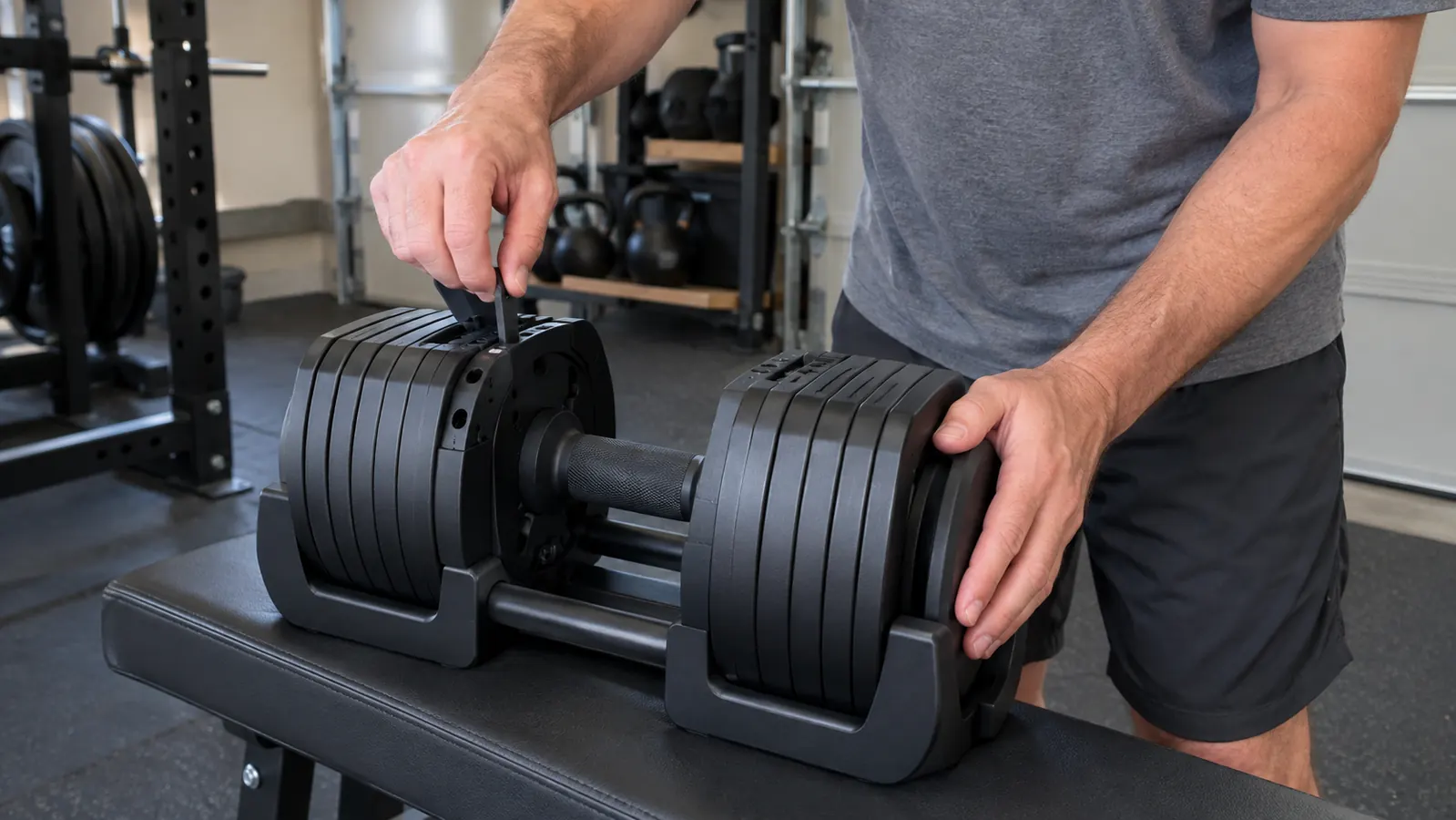
Here is the honest part. The weight change mechanism is the thing everyone talks about, and it is also the thing nobody fully explains. To change weight, you set the dumbbell in the cradle, slide the selector pin into the hole that matches the weight you want, and lift. That sounds simple. The first week, it is not. You will pick up the dumbbell and one plate will stay behind, or you will grab it without the pin fully seated and feel it shift. You will learn the trick, which is to give the handle a little wiggle before you lift. After that, it becomes automatic.
My first failure happened on day two. I had set the pair to 25 pounds for bench press, finished my first set, and reached down to slide the pin to 30. The pin did not want to move, so I pulled harder, the dumbbell tilted, and one plate dropped back into the cradle with a noise that echoed across the whole garage. Nothing broke. It just taught me the correct sequence: set the dumbbell flat, line up the pin, push until it clicks, then lift with the handle straight. After that, the whole thing takes about four seconds per dumbbell.
And the expansion kit. The Elite EXP is designed to grow from 50 to 70 or 90 pounds with add-on kits. That is a nice idea. What nobody tells you is that the expansion kit costs nearly as much as some complete budget dumbbell sets, and that you will probably not buy it. I did not. At 50 pounds, I have room to progress for a long time. If you are already strong enough that 50 pounds is a warmup, buy the 90 pound version from the start.
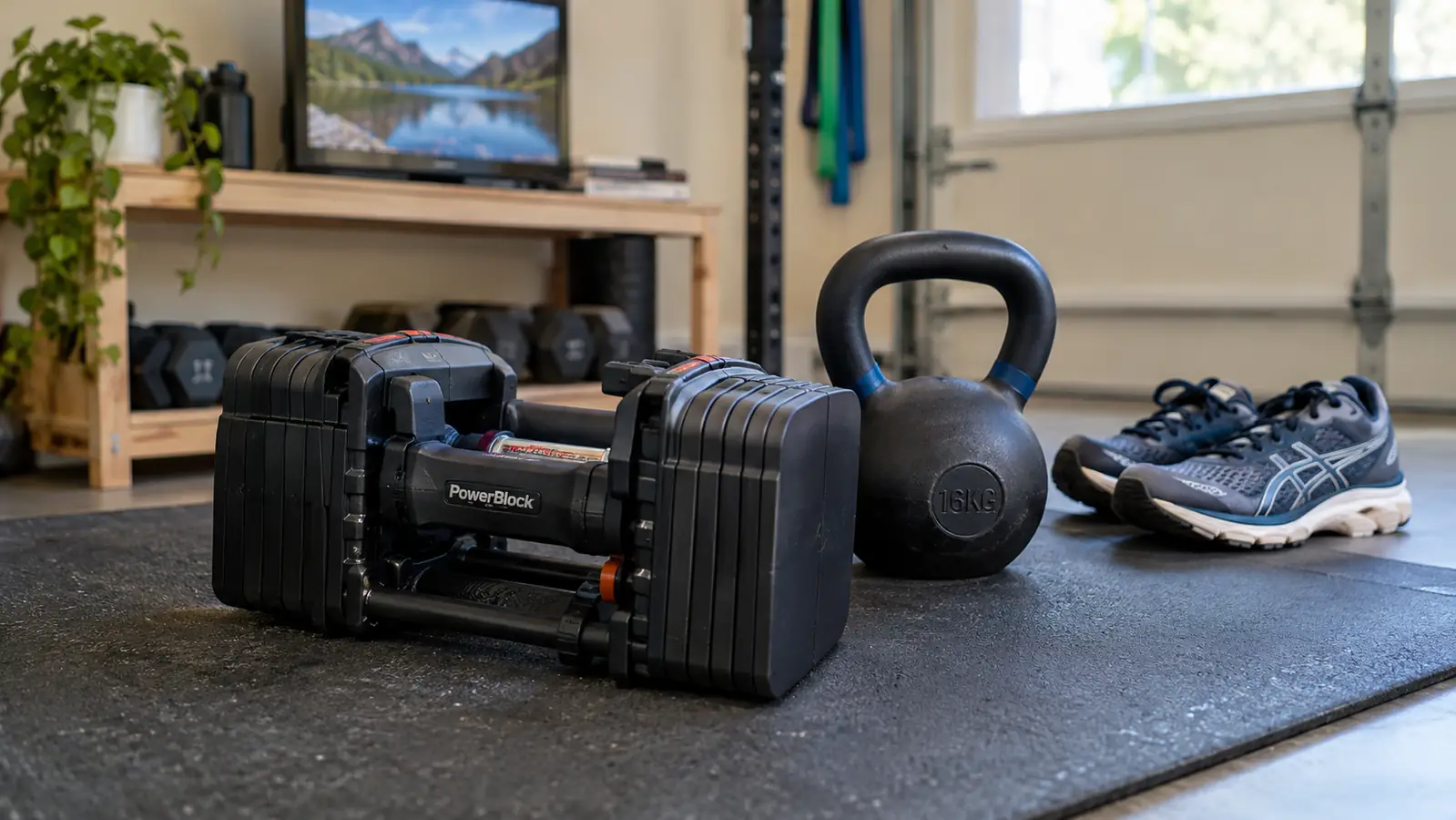
One more thing I did not expect: the plates are noisy when you set the dumbbell down hard. If you lower it gently, there is a soft clack. If you drop it from an inch up, it sounds like a bag of wrenches. On a garage floor over rubber mats it does not matter. Upstairs in a condo, the people below you will know exactly when you finish a set. I measured the cradle out of curiosity one morning, and each one is about 22 inches long and 9 inches wide, which means the pair takes up roughly the same floor space as a small folding table. That is the number I wish I had seen in the product photos. I ended up storing the cradles on a shelf against the wall when they are not in use, which costs me about a minute of setup every workout.
The first week, you will pick up the dumbbell and one plate will stay behind. You will learn the trick, and after that it becomes automatic. Nobody tells you that part.
The Good, the Annoying, and the Ugly
The good is easy. The PowerBlock Elite EXP replaces an entire rack of fixed dumbbells. I had a set of rubber hex dumbbells from 5 to 25 pounds taking up a corner of the garage, and they still did not cover the weights I needed. This one set covers everything from light warmup work to heavy rows. The space savings are real, and the build quality is genuinely good. The welds are clean, the plastic parts feel durable, and after six months of daily use, nothing has broken or worn out.
Here is the concrete version. Before the PowerBlock arrived, the corner of my garage held a two-tier rack with eight pairs of rubber hex dumbbells from 5 to 25 pounds, and I still had to use the gym for anything heavier. That rack covered maybe four feet by two feet of floor and about six feet of wall. The PowerBlock set, with both cradles side by side, takes up a rectangle roughly three feet by two feet and about two feet of height. In a half-garage gym that already holds a bench, a rack, a fan, and a TV shelf, reclaiming that corner was the difference between the room feeling like a gym and feeling like a storage unit. I kept the hex dumbbells for about a month after the PowerBlock arrived, mostly out of habit, and then gave them to a neighbor who was setting up a garage gym of his own.
The annoying is the weight change. It is not slow, exactly, but it is not instant. On a stopwatch, going from 20 to 35 pounds on both dumbbells takes about ten seconds once you know the trick. That is fine between sets. It is not fine when you are doing a circuit and you want to drop from 30 to 15 pounds between exercises, because you will spend more time sliding pins than lifting. For my style, which is straight sets with a real rest period, it is a non-issue. For someone who lives on supersets and drop sets, it will get old by the second week. If you train the way I do, with a notebook and a timer and a real pause between sets, the ten seconds disappears into the rest. If you train on feel and like to chain exercises together, budget for it.
The ugly is the price. These are not cheap. You are paying for the engineering, and the engineering is good, but it is a real investment. The way I made peace with it: I priced what eight pairs of good rubber hex dumbbells would cost, and the math worked out in favor of the PowerBlock. The other part of the math is resale. I have watched used PowerBlock sets sell quickly at close to their original price, which is not something you can say about most home gym gear. If you buy them and decide they are not for you, you are not stuck with a paperweight.
What I Liked
- One pair replaces 5 to 50 pounds of fixed dumbbells, which cleared out a whole corner of my garage
- 2.5 pound jumps up to 25 pounds, so lighter progression is smooth and steady
- Solid build: steel plates, clean welds, nothing loose or broken after six months of daily use
- Two people with different strength levels can share one set without adjusting anything
- Holds resale value far better than most home gym equipment
Where It Falls Short
- Weight changes are slower than grabbing a fixed dumbbell, and drop sets will frustrate you
- The cradles are bulky: about 22 inches long each, and both need floor space during a workout
- The expansion kit to reach 70 or 90 pounds is expensive enough that most people never buy it
- Plates clack loudly if you set the dumbbell down hard, which matters if you have neighbors below
How It Compares to What I Expected
I expected a gimmick. A plastic-heavy contraption that would feel flimsy and break within a month. What I got was a tool that feels like it was designed by people who actually lift. The plates are steel, the handle is comfortable, and the locking mechanism, once you understand it, is secure. I have never had a dumbbell come apart mid-lift, which is the thing I was most worried about.
Before these, I tried two other things. First, a set of resistance bands with handles and a door anchor. They cost little, took up no space, and I used them exactly four times. The problem was not the bands, it was me: the resistance curve felt wrong, the anchor moved when I pulled hard, and I never trusted the math of how much weight I was actually moving. Then I bought a cheap spin-lock adjustable set from a big box store. The collars stripped within a month, the plates wobbled on the handle, and one of them came loose during a curl, which was the end of that experiment. The bands went into a drawer, the spin-lock set went to a yard sale, and I was back at the gym until last fall, when I finally ordered the PowerBlock. It was the third try, and the difference is that I do not think about the equipment while I am using it.
I also expected to use them for a week and go back to the gym. That did not happen. The turning point was a Tuesday in December when work ran late, the gym would have meant a 45 minute round trip, and I still got my workout done between 6:10 and 6:45 in the garage with the fan on and the TV showing the news. The convenience of walking ten feet from the kitchen, doing 35 minutes of work, and being done is the real reason these get used. The gym is twenty minutes away. The garage is twenty seconds away. That difference is the whole ballgame.
Who This Is For
The PowerBlock Elite EXP is for the person who wants to train at home, has a modest amount of space, and is tired of either going to the gym or owning a pile of fixed dumbbells. It is for the person who does not need to look impressive, who just wants to do the work. It is for the person who, like me, has a body that needs low-impact training and a schedule that does not allow for a 45 minute commute to a gym.
Who Should Skip It
Skip it if you are a serious powerlifter who needs heavy dumbbells. Skip it if you hate the idea of a mechanism between you and the weight, and you would rather just grab a fixed dumbbell and go. Skip it if you are on a tight budget and a set of fixed dumbbells in the weights you actually use would cover 80 percent of your workouts. And skip it if you have a very small apartment with no floor space, because the cradles really do take up room.
The Bottom Line
The PowerBlock Elite EXP is the best home gym purchase I have made in years. It is not perfect, and I have told you exactly where it falls short. But for a 51 year old with a cranky knee, a garage, and 30 minutes in the morning, it is the difference between training and not training. That is worth a lot.
Still deciding? The PowerBlock Elite EXP is the set I kept.
If you want one pair of dumbbells that covers 5 to 50 pounds and actually gets used, check today's price on Amazon. If it is not right for you, at least you will know what to look for.
Amazon Check Today's Price on Amazon →